TL;DR: For one Leeds restaurant, Tidio's Lyro is the cheapest start — £24 a month plus Lyro from £32 — but AI chats are metered and the bill climbs. Fin resolves best at $0.99 per outcome; Zendesk AI is the ticket machine at $1.50–$2.00 per resolution over $55 seats. Neither fits a 40-seat restaurant. The gap is an agent that answers phone, WhatsApp and chat, books tables, and charges one flat price: VisionQuantech installs it for $99 setup and $25 a month.
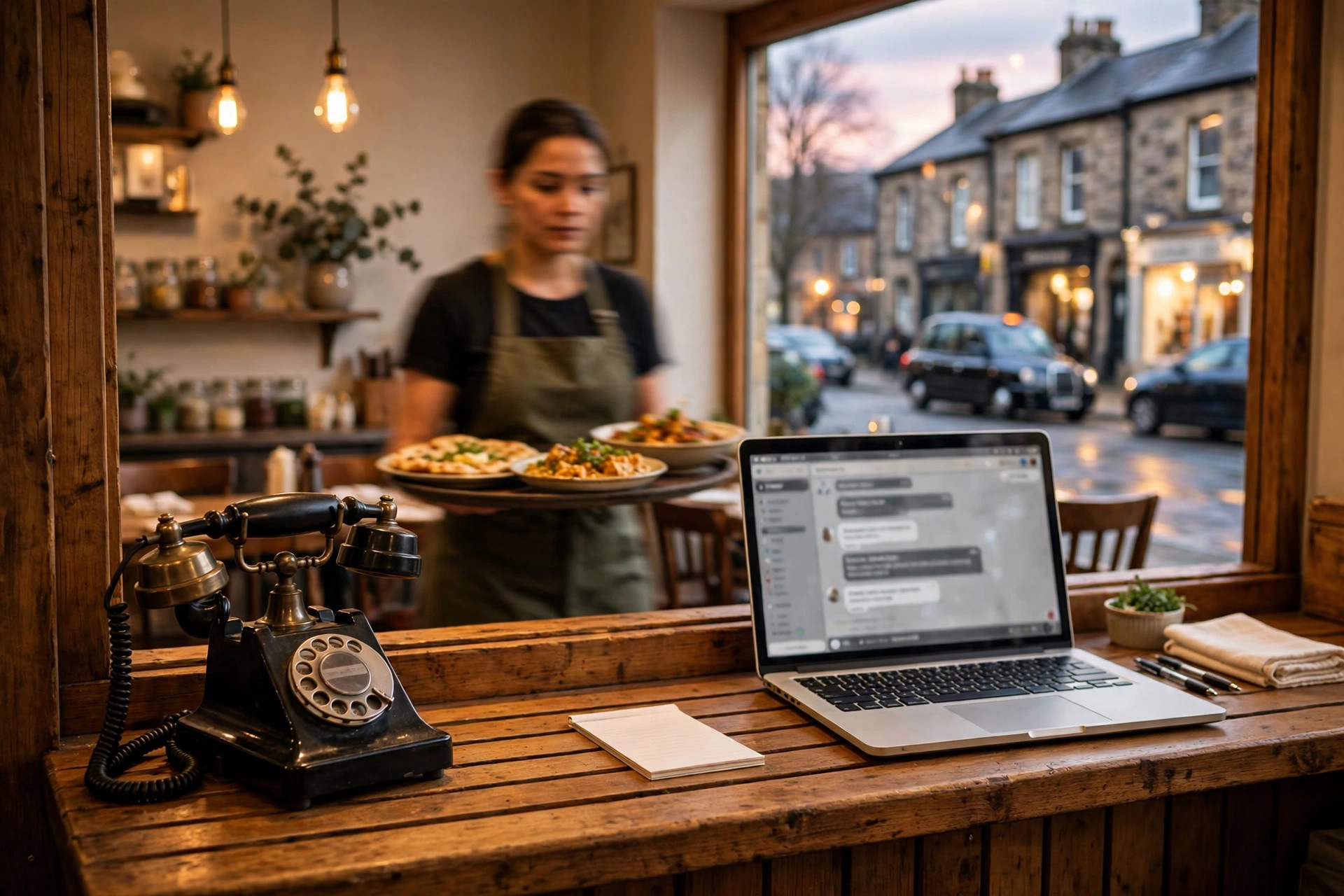
Meet Priya — and the Friday her Leeds restaurant lost eleven bookings
Priya runs a 40-seat north Indian restaurant on Briggate, Leeds city centre. Friday is her money night: the dining room fills by 7 p.m., the takeaway phone never stops, and the two staff on the floor are carrying plates.
One Friday in October she counted. Between 6 p.m. and 10 p.m. the phone rang 31 times. Eleven calls went unanswered — the team was mid-service, the phone was on the pass, and nobody could pick up. Seven of those eleven were people trying to book a table or order takeaway. At an average table value of about £85–£120 per booking, that one Friday cost her roughly £600–£800 of revenue she will never see again. The callers did not leave voicemails. They booked somewhere else on Kirkgate.
Priya is not unusual. HeyGuest with OpenTable research (August 2026, 500,000+ restaurant calls) found 43% of restaurant calls go unanswered, and 60% of those missed calls are revenue inquiries — bookings, takeaway orders, private events. Nearly seven in ten customers (69%) give up if nobody answers, and 85% will not call back after voicemail. The average restaurant takes 150–200 calls a week — 65–86 unanswered at a 43% miss rate.
This piece answers Priya's question: which AI customer support agent actually fits a restaurant like hers in Leeds — not a software company, not a call centre, a restaurant — and what each one really costs once the meters start running.
What an AI support agent does in a restaurant (and what it is not)
An AI support agent is software that answers your customers on the channels they already use — website chat, WhatsApp, Instagram, email and, on some tools, the phone — and resolves the routine stuff without a human: opening hours, the menu, allergen questions, "do you have a table for four at 8?", "can I change my booking?", "is the chicken tikka gluten-free?"
It is not a chatbot that only answers FAQs and dies on anything unscripted. It is not an AI receptionist, which is a voice agent for the phone line. And it is not a helpdesk: a helpdesk organises tickets for your team, while an agent closes the conversation itself. The best test of any tool in this category is simple — does it resolve the enquiry, or does it just file it faster?
For a restaurant, the agent must also do things a SaaS support bot never does. It must know today's menu and what is sold out, check a real booking diary instead of promising a table that does not exist, and handle allergy questions safely — a wrong answer about nuts or gluten is not a bad review, it is a health risk. And it must hand over to a human the second a customer is upset, because an angry diner argued with by a bot becomes a one-star Google review within the hour. Gartner predicts agentic AI will resolve 80% of common customer service issues without human intervention by 2029 — the question is which vendor's version is built and priced for a restaurant her size.
The Leeds maths: what the missed calls are actually worth
Her restaurant takes about 170 calls a week — about 73 unanswered at the 43% miss rate, and roughly 44 of those are people trying to spend money.
Not every one would have become a booking. Suppose the agent answers them all and converts just one in four into a confirmed table or takeaway order at an average party value of £90: 11 bookings a week, about £990 a week, roughly £51,000 a year walking to the restaurant next door — £25,000 a year even at half that conversion. One pizzeria case study recovered £156,000 a year simply by making sure every enquiry reached someone or a booking alternative.
Illustrative maths from published industry figures, not a forecast — a quieter spot loses less, a busier one more. The question is not "can I afford an AI agent?" but "can I afford 44 unanswered money calls a week?"
The four options, priced for one Leeds restaurant
For a restaurant, the honest shortlist is three big names plus the done-for-you alternative. (For the phone-only side of the same problem, see our AI answering service for restaurants guide.) Every price below was read from vendor pages or published 2026 comparisons; confirm before you buy — this category reprices constantly.
1. Intercom Fin — the best resolver, priced for software companies
Fin is Intercom's AI agent — the company rebranded as Fin in 2026, and Salesforce completed its acquisition on 10 September 2026 for a reported ~$3.6 billion. It scores 4.5 out of 5 on G2, from about 3,900 reviews.
Seats start at $29 per seat per month on Essential, billed annually (Advanced $85, Expert $132) — then Fin charges $0.99 per resolved outcome. A "resolution" counts when the customer confirms the answer helped, or simply stops replying — Fin calls that an assumed resolution. At 1,000 resolutions a month, that is $990 before a single seat fee. No free plan; a 14-day trial is offered.
2. Zendesk AI — the heavy-duty ticket machine
Zendesk is the long-standing standard for large, process-heavy support operations: ticket routing, SLA management, permissions, voice, and a large app marketplace. It scores 4.3 out of 5 on G2, from more than 7,000 reviews.
Suite Team starts at $55 per agent per month, billed annually (a limited email-only Support Team plan starts at $19–$25), and AI agents cost about $1.50 per automated resolution committed, or $2.00 pay-as-you-go. Since May 2026, every Suite plan includes a small monthly resolution allowance — about 5 to 10 per agent — and then the meter runs. The Copilot add-on costs about $50 per agent per month. Reviewers praise the ticketing depth; the recurring complaint is complex pricing and add-ons.
For Priya: Zendesk is the right tool if she ran a 50-seat support team. She runs a restaurant. A 20-agent team on Zendesk Suite Professional lands near $1,100 a month on seats alone — Priya has two front-of-house staff. It would also need a booking-system integration building, and Zendesk's own support averages a 24-hour first response — slower than the dinner rush allows.
3. Tidio Lyro — the cheapest honest start, with a bill that climbs
Tidio bundles live chat, email and social messages into one inbox, with an AI agent, Lyro, that answers from your own content. It scores 4.6 out of 5 on G2, from 1,962 reviews, and 4.7 on Capterra — but 3.5 to 3.7 out of 5 on Trustpilot, from about 225 reviews, where the recurring complaints are hard-to-reach support, unexpected price changes and cancellations.
The price is three meters — and this is where buyers get caught. The platform is free for 50 billable conversations a month, then Starter at $24.17 a month billed annually ($29 monthly) for 100 conversations, Growth from $49.17, Plus from $300. Lyro is a separate add-on: from $39 a month for 50 AI conversations, or $32.50 billed annually; the free plan includes only 50 Lyro conversations as a one-off, not monthly. Tidio markets a resolution rate of up to 67% for Lyro, and guarantees 50% only on the Premium plan. In G2's October 2026 hands-on evaluation, Lyro scored 218.8 out of 250, with 93% accuracy and 92% policy compliance — a genuinely strong result.
For Priya: Lyro is the best fit of the three big names for a small restaurant. It is live in an afternoon, works on the website chat bubble and WhatsApp, and the entry price is real money, not enterprise money. The traps are the ones G2 reviewers name most: "expensive" and "cost" are the most common complaint tags, because live chat, Flows and Lyro are metered separately, and Tidio's terms promise no refund for unused time. A busy Friday can push her over the conversation quota mid-service, and there is no phone voice agent — Lyro is chat, not the phone line where her 43% problem lives.
4. VisionQuantech AI Support Agent — the done-for-you option
VisionQuantech does not sell Priya a dashboard. It installs an AI support agent on her restaurant — phone, WhatsApp, web chat and Instagram in one agent — trained on her actual menu, allergen list, opening hours and booking diary, with a human handover the moment a customer is upset or asks something the agent cannot verify. It books tables into her real diary, takes takeaway orders, answers allergen questions from her approved list, and texts confirmations.
One flat number, not three meters: a $99 founding setup and $25 a month maintenance, lifetime-locked for the first three customers — no per-resolution charge, no per-seat charge, no conversation quota to trip over on a Friday night. The install is done live on a 15-minute call — Priya watches her own phone number answer its first call.
The honest limit: VisionQuantech is a one-person specialist practice, not a platform with 7,000 G2 reviews. She can watch a live setup call on her own number and judge the agent by how it handles her own menu. A demo on your own business beats a review page every time.
The comparison table
| Intercom Fin | Zendesk AI | Tidio Lyro | VisionQuantech AI Support Agent | |
|---|---|---|---|---|
| Best for | SaaS teams already on Intercom | Large teams with heavy ticketing | Small shops needing chat + WhatsApp fast | One restaurant, done for you |
| G2 rating | 4.5/5 (~3,900 reviews) | 4.3/5 (7,000+ reviews) | 4.6/5 (1,962 reviews) | New — judge by live demo |
| Starting price | $29/seat/mo + $0.99 per resolution | $55/agent/mo + $1.50–$2.00 per resolution | $24.17/mo + Lyro from $32.50/mo | $99 once + $25/mo flat |
| Phone voice agent | Yes, on higher plans | Yes, as an add-on | No — chat only | Yes, included |
| Books into your diary | Only via custom build | Only via custom build | No | Yes, included |
| Menu + allergen knowledge | You build it | You build it | From your website content | Trained on your menu, included |
| Human handover | Yes | Yes | Yes | Yes, instant on upset customers |
| Free plan / trial | 14-day trial, no free plan | 14-day trial | Free plan (50 chats/mo) | 15-min live setup call |
| Biggest weakness | Two meters; Salesforce roadmap risk | Price + complexity for a small team | Three separate meters; no phone agent | Small vendor; no thousand-review track record |
Seven questions that separate a real restaurant agent from a dressed-up chatbot
Ask every vendor these seven, in writing, before you pay.
1. Does it book, or does it take a message? An agent that only takes messages is a voicemail with better manners. The booking must happen in the call or chat, on your real diary, confirmed and texted to the customer. Ask for a live demo booking on your own diary.
2. Does it know today's menu — including what is sold out? A restaurant agent must know the sea bass is off tonight and the tikka is gluten-free but the naan is not. If the vendor cannot show you a sold-out dish handled correctly, it has not built a restaurant product.
3. What does it do with an allergy question? The safe answer is: it answers only from your approved allergen list, and hands over to a human for anything outside it. A bot that guesses about nuts is a liability, not a feature. In the UK, a business is responsible for what its AI agent says, as for an employee (UK CMA, March 2026; fines up to 10% of worldwide turnover) — "the AI said it" is not a defence.
4. How does it hand over to a human? The handover must be instant, with the whole conversation attached, on the customer's channel — not "please call us back." Test it: send an angry message in the demo and time how long before a human sees it.
5. What does it refuse to do? A good agent knows its limits: no discounts it was not told about, no prices outside your approved list, no card details in chat — payments belong in a proper payment link. Ask the vendor to list its refusals in writing.
6. How is the bill actually calculated? Seats plus resolutions, conversations plus Lyro, agents plus add-ons — every big vendor has at least two meters. Make the vendor model your real volume — 170 calls and chats a week, Friday and December peaks. If they will not put a monthly number in writing, the price is not the price.
7. Who sets it up, and what happens on a Friday night when it breaks? Self-serve setup means you are the IT department. Ask who configures the menu, who trains the agent, and who answers when the agent goes down at 7 p.m. on a Friday. A vendor with no answer for Friday night has no answer at all.
Clear answers mean a real product; vague ones mean a chatbot with a sales page.
The five-step switch, in Priya's week
Step 1 — Monday morning: count the leak. Priya exports one week of call logs, counts unanswered calls, and marks how many were booking or order intent. Most restaurants are shocked by the number — that number is the business case, and it takes twenty minutes.
Step 2 — Tuesday: the live test. She books a 15-minute live setup call and watches an agent answer her own number, handle a table-for-four request, answer an allergen question, and hand over an angry customer. Two live calls — pass both and it is a real agent.
Step 3 — Wednesday: the menu upload. She sends the menu, allergen list, opening hours and diary access. The agent is trained on those documents only — nothing from the open internet, nothing guessed. This step decides whether the agent is safe to put in front of customers.
Step 4 — Thursday: the soft launch. The agent answers only website chat and WhatsApp for one evening, while the phone stays with the team. Priya reads every conversation next morning; anything wrong gets fixed before the phone goes live.
Step 5 — Friday: full service. The agent takes the phone from 6 p.m., the busiest window, with the team watching the handover queue. Every call answered, every booking confirmed by text, every upset customer with a human in seconds. Priya compares the week's unanswered-call count with the week before, and the decision makes itself.
What the YouTube mining and the reviews agree on
Two extra feeds shaped this piece (Borja Obeso method). On YouTube, the top recent AI-agent videos — Matt Wolfe's system-build walkthrough, AI Explained's benchmarked explainer, Wes Roth's agent stories, Tech Simplified's single-example format, Nova AI's two-minute Shorts — all teach the same lesson: the videos that perform show a real system doing real work, with numbers on screen, not slides about the future. Commenters keep asking the same questions: what does it cost at real volume, what happens when it gets something wrong, and who fixes it?
The reviews say the same thing. Across G2, Capterra and Trustpilot, buyers love the resolution quality and the setup speed, and complain about the same three things — bills that climb because of stacked meters, support that is hard to reach when something breaks, and refund terms that punish annual prepayment. Zendesk's 2026 Customer Experience Trends Report found 70% of consumers see a clear gap between companies that use AI well and those that do not — the gap is execution, not technology.
The verdict for a restaurant in Leeds
If Priya already runs on Zendesk with a support team, she should buy Zendesk AI and not look back. If she is a SaaS founder moonlighting as a restaurateur, Fin is the best resolver money can buy. If she wants the cheapest self-serve start and is happy in chat only, Tidio Lyro is the honest pick — with eyes open about the three meters and the refund terms.
But Priya is none of those: a restaurant owner with 170 calls a week, 44 of them money, and no IT department. For her, the best AI customer support agent is the one that answers the phone, knows her menu, books into her diary, charges one flat price, and is installed by someone else on a live call. That is the VisionQuantech AI Support Agent: $99 founding setup, $25 a month, lifetime-locked for the first three customers. See the full list of VisionQuantech services. The live test takes fifteen minutes, on her own number, with her own menu — if it cannot book a table for four on a Friday, she should not pay a pound, and neither should you.
Frequently asked questions
What is the best AI customer support agent for a small restaurant?
For a small restaurant, the best agent is the one that answers the phone as well as chat, knows your menu and allergen list, books into your real diary, and charges one predictable price. Of the big platforms, Tidio Lyro is the cheapest start for chat only; Intercom Fin resolves best but is priced for SaaS teams; Zendesk AI suits large operations. See also our best AI chatbots for small business comparison. A done-for-you install, such as VisionQuantech's AI Support Agent at $99 setup and $25 a month, fits a single restaurant better than any of the three, because the setup, menu training and billing are all handled for you.
How much does an AI customer support agent cost for a restaurant in Leeds?
It depends on the billing model. Intercom Fin costs $29 per seat per month plus $0.99 per resolved conversation. Zendesk AI costs from $55 per agent per month plus $1.50–$2.00 per automated resolution. Tidio costs from $24.17 a month plus Lyro from $32.50 a month for 50 AI conversations. VisionQuantech charges a flat $99 once and $25 a month, with no per-resolution or per-seat meter. Always ask a vendor to model your real weekly volume before you sign.
Can an AI support agent handle allergy questions safely?
Only if it answers strictly from your approved allergen list and hands anything outside that list to a human immediately. A safe agent never guesses about allergens, never invents ingredients, and never takes card details in chat. In the UK, a business is responsible for what its AI agent says in the same way as for an employee, so the allergen list must be yours, written down, and loaded into the agent — not scraped from the internet.
Can an AI support agent take restaurant bookings and takeaway orders?
Yes, if it is connected to your booking diary and ordering flow. Fin and Zendesk can do this only through custom builds. Tidio's Lyro handles chat-based enquiries but has no phone voice agent and no native booking integration. A restaurant-specific install books tables into the real diary, confirms by text, and takes takeaway orders with collection times.
What happens when a customer is angry — does the AI argue with them?
A well-built agent never argues. It recognises frustration, apologises once, and hands the conversation to a human immediately, with the full thread attached. Ask any vendor to demonstrate an angry-customer handover live, and time it. If the bot tries to resolve a complaint about food safety or a refund on its own, do not buy it.
Do I need to change my phone number or booking system?
No. A done-for-you agent works on your existing number and your existing diary — OpenTable, Resy, SevenRooms or a paper book, with the agent trained on how your team actually takes bookings. The big platforms may need integrations or a new number; ask before you commit, and never let a vendor make your Google Business Profile number a dead end.
References & further reading
- HeyGuest / OpenTable — "43% of Restaurant Calls Go Unanswered" (EINPresswire, 25 Aug 2026): https://www.einpresswire.com/article/936096880/43-of-restaurant-calls-go-unanswered-heyguest-partners-with-opentable-to-help-operators-capture-more-bookings
- Reservaii — "How Many Restaurant Phone Calls Go Unanswered (And What It's Costing You)" (6 Mar 2026): https://www.reservaii.com/blog/missed-calls
- Rankite — "Customer Service Software With the Best AI Support in 2026: 8 Tools Compared": https://rankite.com/blog/customer-service-software-with-best-ai-support
- HelpCrunch — "Intercom vs Zendesk: Which Support Tool Wins in 2026?": https://helpcrunch.com/blog/zendesk-vs-intercom/
- Kayako — "Zendesk vs Intercom: An Honest 2026 Breakdown": https://kayako.com/tools/zendesk-vs-intercom/
- Tidio — "11 Best AI Agents for Customer Service in 2026": https://www.tidio.com/blog/best-ai-agent-for-customer-service/
- Tidio — "10 Best AI Customer Support Software in 2026": https://www.tidio.com/blog/ai-customer-support-software/
- GetMacha — "Tidio Review 2026: Scored 26/30, Prices From $24.17": https://www.getmacha.com/blog/tidio-review
- Sobot — "AI Chatbot Platforms: How to Choose the Right Software": https://www.sobot.io/blog/ai-chatbot-platforms-how-to-choose/
- Zendesk — "21 best customer service software for 2026": https://www.zendesk.com/service/ticketing-system/customer-service-management-software/
Cite this article: Shivam Kumar (2026). What's the Best AI Customer Support Agent for a Restaurant in Leeds?. VisionQuantech. https://visionquantech.com/blog/best-ai-customer-support-agent-restaurant-leeds.html