TL;DR: A small Seattle electronics store hiring 8 to 12 retail associates a year needs the AI recruiter priced for that volume. Paradox (Olivia) starts around $1,000 a month and HireVue around $35,000 a year — both built for chains hiring thousands, neither publishing a price list. The ladder runs from $468 a year (Hirevire) through Manatal at $15 a user a month to VisionQuantech's managed AI Recruiter at $99 setup plus $25 a month. Buy screening and scheduling; keep a human making the final call.
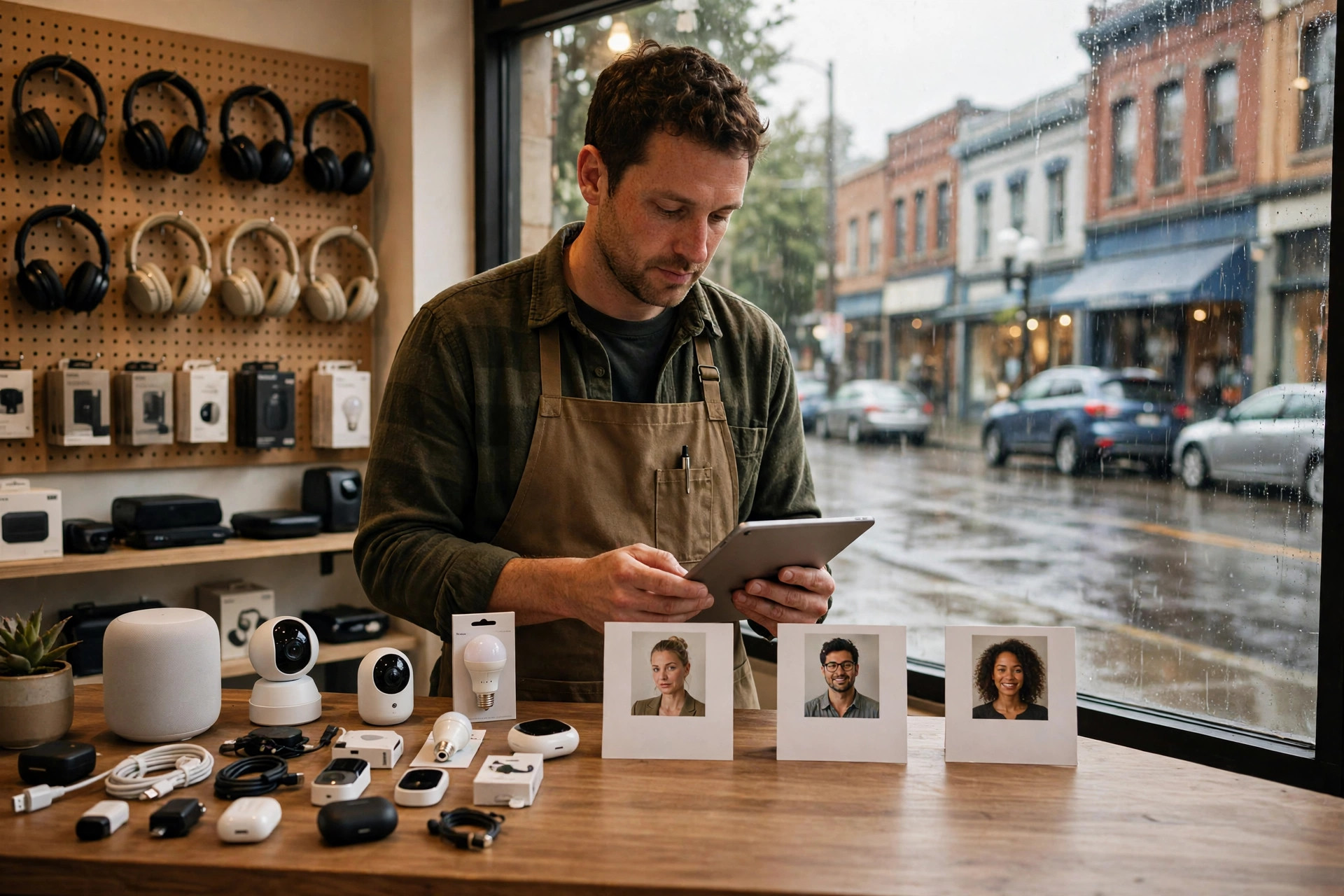
Meet Priya — and the Tuesday her Ballard electronics store lost its best salesperson
Priya runs a small electronics store on Ballard Avenue in Seattle — headphones, smart-home gear, and phone accessories on the shop floor and through her Shopify store, six staff, a busy holiday season coming. On a Tuesday morning in November, her best salesperson handed in notice — a better-paying warehouse job in Kent — and by lunch Priya had 43 applications in her inbox for one open role.
She is the owner, the buyer, the person who unboxes the deliveries, and now the recruiter. Every application needs a read. Every promising candidate needs a phone call, usually after closing time, usually unanswered. The good ones — the ones who actually know the difference between a mesh Wi-Fi system and a range extender — get snapped up by the Best Buy two miles away while Priya is still working through the pile. By Friday she has interviewed four people. Two never showed up. One wanted $28 an hour. The last one starts Monday and quits the following Thursday.
This piece answers Priya's question: which AI recruiter fits a store her size, what does each one cost, what does each one get wrong, and how do you switch without breaking the way you hire?
The short answer: an AI recruiter does four jobs, and you only need two of them
An "AI recruiter" is not one tool. It is four different jobs sold under one name, and the first mistake is buying all four when you only need two:
Job 1: sourcing. Finding candidates — searching databases, writing job posts, paying for reach. Tools like SeekOut and HireEZ live here. A small electronics store does not need this: Priya's problem is not finding applicants. Forty-three people applied for one role.
Job 2: screening. Reading applications, asking the knock-out questions, and ranking who is worth a call — weekend availability, lifting 40 pounds of boxed TVs, any electronics-sales experience. This is the job eating Priya's week, and an AI assistant can ask all of it over text or voice and hand the owner a shortlist.
Job 3: scheduling. Booking interviews, sending reminders, chasing no-shows. Two of Priya's four interviews never happened — a reminder text the night before would probably have saved one of them.
Job 4: interviewing. Conducting the interview — voice or video — and scoring the answers. This is where the expensive platforms live, and the job a ten-person store least needs. Priya interviews four people per hire in one afternoon. What she cannot do is read 43 applications and make 20 phone calls.
So the rule for a store Priya's size: buy screening and scheduling, skip sourcing and interviewing. Every tool below is judged on exactly that — and the enterprise platforms lose because they bundle all four jobs and charge for all four.
What hiring costs Priya today — the maths before any price
Before prices, count the cost of the status quo, because that is the number every AI price has to beat. The figures below are labelled assumptions for a ten-person Seattle electronics store.
Retail turns over fast. Bureau of Labor Statistics JOLTS data for 2025 shows retail trade averaging a 3.8% monthly separations rate — roughly 46% of the workforce over a year — with quits alone at 2.6% a month. For Priya's team of ten, that is about four or five departures a year, plus three seasonal hires for the holiday rush. Call it eight hires a year.
Each hire costs Priya roughly eight hours of her own time: posting the role, reading 40-plus applications, phone-screening six people, interviewing three or four, checking references. Eight hires times eight hours is 64 hours a year — a week and a half of the owner's time. At a loaded $35 an hour, that is about $2,240 a year, before job-board spend. Add sponsored Indeed posts at roughly $150 a hire and the total is around $3,440 a year — plus empty shifts, overtime for the staff covering them, and sales lost on a short-staffed Saturday.
That $3,440 is the number that matters. Any tool costing more has to prove it saves more than the whole problem costs. Two of the biggest names in AI recruiting fail that test for a store Priya's size — by a lot.
The price ladder: what AI recruiting costs in November 2026
The ladder, cheapest first, with real November 2026 prices — no invented numbers. "Third-party estimate" means the vendor does not publish the price and has not confirmed it.
Hirevire — $468 a year. Recorded video screening only: candidates record answers, you watch the best ones. Published price, 7-day free trial, G2 4.7 out of 5 from 30 reviews. One job, done cheaply — but no texting, scheduling, or candidate questions.
Manatal — from $15 per user a month ($19 month-to-month). An AI-native applicant tracking system with AI matching, resume parsing, and an optional AI video-interviewer add-on from $40 a month for 20 interviews. For Priya: one user, $180 a year, add-on only in hiring months. The cheapest full ATS with real AI — but you run it yourself.
Edesy — from $99 a month. The one here that actually conducts AI interviews by voice and video — the AI asks, follows up, and evaluates, in 60-plus languages. Published price, no sales call. For a store hiring eight people a year, $1,188 a year is a third of Priya's whole hiring cost — steep, but the price is printed on the website.
Spark Hire — from $149 a month. Video interviews plus scheduling — less AI than Paradox, but a real interview capability small businesses can buy without a quote. $1,788 a year. You still interview people yourself; the scheduling and the recorded first round stop eating your evenings.
Workstream — quote only. The hourly-hiring platform for restaurants and retail chains: text-to-apply, QR-code applications, and a VoiceAI that phones and screens candidates. Third-party estimates put it around $109 to $399 per location per month; Workstream publishes no price and sells per-employee-per-month after a demo. G2 reviewers rate it the better small-business fit against Paradox — but it is built for operators with five or more locations, not one Ballard shop.
Paradox (Olivia) — from about $1,000 a month. The conversational AI that texts candidates 24/7 in 100-plus languages, screens them, and books interviews. No published price, no free trial; every path funnels to "Request demo." Third-party estimates put entry at $1,000 a month ($12,000 a year), mid-market at $25,000 to $60,000 a year, and national enterprise at $75,000 to $150,000-plus a year. G2 reviewers report a 12% average discount, about two months to implement, and about seven months to earn the cost back. For Priya, the entry price alone is three and a half times her entire annual hiring cost — the right tool for McDonald's, which runs Olivia across all 15,000 US stores, and the wrong tool for one shop in Ballard.
HireVue — from about $35,000 a year. Structured AI video interviews with competency-based scoring, plus skills tests. No published price; G2 lists Essentials starting at $35,000 a year, with setup fees reported at $15,000 to $40,000. Built for graduate and professional hiring at scale — Unilever cut interview time by 90% with it, across 150 countries. For a store hiring eight retail associates a year, it costs ten times the whole problem; the set-up fee alone is four times Priya's annual hiring spend.
VisionQuantech AI Recruiter — $99 setup plus $25 a month. A managed AI employee that does the two jobs a small store needs: it screens applicants over text and voice, asks the knock-out questions, books interviews on your calendar, and sends reminders. The owner makes the final call, always. First-year cost: $399 — roughly one-ninth of Priya's current $3,440 hiring cost, and the only entry on this ladder where somebody else runs the tool for you. See our AI services and the AI Recruiter page. Related: AI data analyst vs hiring a data analyst and how much an AI SDR costs a small business.
The comparison table
| Tool | What it actually does | Published price? | Entry cost | Best for | The catch for a small store |
|---|---|---|---|---|---|
| Hirevire | Recorded video screening only | Yes | $468/yr | Cheapest screening | No texting, no scheduling |
| Manatal | AI ATS + matching + optional AI interviewer | Yes | $15/user/mo | Cheapest full system | You run it yourself |
| Edesy | Full AI voice/video interviews | Yes | $99/mo | Automating round one | $1,188/yr for 8 hires |
| Spark Hire | Video interviews + scheduling | Yes | $149/mo | Recorded first round | Still needs your time |
| Workstream | Text-to-apply + VoiceAI screening + payroll | No — quote only | ~$109–399/location/mo (third-party estimate) | Multi-location hourly hiring | Built for 5+ locations |
| Paradox (Olivia) | 24/7 chat screening + scheduling | No — quote only | ~$1,000/mo (third-party estimate) | Chains hiring thousands | 3.5× Priya's whole hiring cost |
| HireVue | AI video interviews + scored assessments | No — quote only | ~$35,000/yr (third-party report) | Graduate/professional scale | 10× the whole problem |
| VQ AI Recruiter | Managed screening + scheduling, human decides | Yes — $99 + $25/mo | $399 first year | One small store | Set up for you, not self-serve |
Step 1: Count your hires before you buy anything
Write down how many people you hired last year, and how many you expect next year. Priya's number is eight. If yours is under 20, cross out every quote-only enterprise tool immediately — Paradox, HireVue, and Workstream's full platform are priced for volume you do not have, and their own reviewers say the return "depends heavily on hiring volume." This one step eliminates half the market in five minutes.
Step 2: Run the 10-candidate test on your real applicants
Do not trust a vendor demo — it uses five clean, polite, perfectly qualified fake candidates. Your applicants are not that. Take your last ten real applications — no phone number, wrong role, "yes" to every question — and run them through the free tier or trial. Check three things: does it catch the candidate who cannot work weekends, does it handle the candidate who asks about pay first, and does it flag the application with no contact details instead of silently dropping it? Pass all three and it will survive your real inbox.
Step 3: Check the disclosure and bias rules before the first candidate
This is the step Seattle stores skip, and the one that can cost the most. Washington state has no AI-hiring law for private employers yet — three bills (HB 2157, SB 6284, and SHB 1672) all died when the 2026 session ended in March, with similar proposals expected back in January 2027. But the Washington Law Against Discrimination already bars employers with eight or more employees from discriminating in hiring, whether the decision comes from a person or a program — and Priya's store, at ten staff including herself, is covered. New York City requires a bias audit, Illinois restricts AI video interviews, and Colorado's AI Act takes effect in January 2027. The safe setup: tell candidates an AI assistant will screen them, let them ask for a human review, and never let the AI reject anyone on its own. Ask the vendor, in writing: does your tool make rejection decisions, and can you show me how it was tested for bias? If the answer is vague, that is your answer.
Step 4: Keep the human decision — and the human phone call
The failure mode that matters: an AI screen feels objective, so owners stop checking it. An AI that rejects a good candidate looks like a system working correctly — and nobody notices until the role has been open for six weeks. So never let the tool reject anyone outright. The split that works: AI screens and ranks, a human reads the top ten and makes every decision, and the owner still makes one short phone call before the interview. Five minutes, voice to voice, catches what no transcript catches: does this person want to sell electronics, or do they want any job? That is the whole quality system, for less than an hour a week.
Step 5: Measure time-to-first-interview, not time-to-hire
Time-to-hire is a vanity number — it mostly measures how long your calendar was full. The number that decides whether good candidates stay in your funnel is time-to-first-interview: how fast a promising applicant gets a real conversation after applying. Paradox's own customer stories show the scale: recruitment firm Cielo cut scheduling time from about 26 hours to 18 minutes, and Compass Group hires 160,000 workers a year with a team of 20. For Priya, the target is simple: every qualified applicant gets an interview slot within 48 hours of applying. Measure it for one month before the tool and one month after. If the number does not move, the tool is not working, whatever the dashboard says.
What AI recruiting gets wrong — the honest list
It deflects off-script questions. The most consistent complaint in Paradox's G2 reviews: Olivia gets repetitive or hands off to a human the moment a candidate asks anything nuanced — pay bands, shift patterns, whether the role is really full-time. Job seekers on Reddit report the loop as frustrating. For a small store that matters more than for a chain: your candidates are neighbours, and a bad first interaction is a lost customer as well as a lost hire.
It can carry bias, and the law is catching up. In 2025 the ACLU of Colorado filed a discrimination complaint against Intuit and HireVue over AI-scored hiring. The complaint is a reminder, not a verdict — but it is why Step 3 exists. Any tool that scores candidates can score them unfairly, and "the AI decided" is not a defence under anti-discrimination law.
Candidate data is a real risk. In July 2025, a breach of McHire — the McDonald's hiring platform Paradox powers — exposed up to 64 million applicant records, through an admin account reportedly using the password "123456." A governance failure, not a model flaw — but it is your applicants' names, phone numbers, and work histories at stake. Before any tool touches your candidates, ask where the data lives, who can see it, and whether the vendor trains its models on it — in writing.
Enterprise tools take two months to set up — with no free trial. G2 reviewers report about two months to implement Paradox, and there is no free trial: every step happens after you sign. Two months of setup for a problem that costs $3,440 a year. The tools with published prices and free trials — Hirevire's 7-day trial, Manatal's monthly billing — let you test on real applicants before committing a dollar.
It cannot sell the job. An AI can screen for weekend availability. It cannot tell a good candidate why your store beats the Best Buy two miles away — the hours, the team, the discount on gear they care about. That pitch still belongs to the owner, in a human voice, before the interview.
The Seattle angle: why a Ballard electronics store feels it first
Seattle is the most expensive place in Washington to hire hourly staff. The city's minimum wage is $21.30 an hour for every employer from 1 January 2026, up from $20.76 in 2025 — against a state minimum of $17.13. No tip credit, no small-employer rate. At $21.30, a bad hire who leaves after three weeks costs roughly $2,550 in wages alone, before training time and the empty shifts that follow. Hiring right the first time is worth more in Seattle than almost anywhere else — and hiring slowly costs overtime for the staff covering the open role.
The regulatory picture is the opposite of the wage picture: Washington is still writing its AI-hiring rules. The three 2026 bills died in March, the state AI Task Force's final report landed in July 2026, and the 2027 session starts on 11 January. A store that sets up disclosure, human review, and a no-AI-rejection rule now is already compliant with the law most likely to arrive in 2027. That is the cheapest insurance in this piece: three sentences in the job post, one line in the screening message, and a human making every final call.
And the competition is local and immediate. Priya's candidates are also applying to Amazon's warehouses, to Best Buy, to the Apple Store downtown — all with recruiting teams and same-day responses. A small store cannot outspend them. It can out-respond them: a text back in ten minutes, an interview booked the same evening, a human voice within 48 hours. That speed is the whole advantage, and it is the one thing an AI recruiter actually buys you.
Frequently asked questions
Which AI recruiter is best for a small electronics store in Seattle?
The one priced for your volume. For 8 to 12 hires a year, that means a published-price tool — Hirevire at $468 a year for recorded screening, Manatal from $15 a user a month as a full ATS, or a managed service like VisionQuantech's AI Recruiter at $99 setup plus $25 a month. Paradox (about $1,000 a month) and HireVue (about $35,000 a year) are built for chains hiring thousands, and both cost more than the entire hiring problem they would solve.
How much does an AI recruiter cost for a small business?
From $468 a year for recorded screening only, to about $1,000 a month for Paradox's conversational screening, to about $35,000 a year for HireVue's scored video interviews — with setup fees reported at $15,000 to $40,000 on top. The middle is $15 to $149 a month for Manatal, Edesy, and Spark Hire. A small store hiring under 20 people a year should expect to pay $400 to $1,800 a year, not five figures.
Can an AI recruiter replace a human interviewer?
No — and for a small store it should not try. The AI's job is screening and scheduling: reading applications, asking knock-out questions, and booking interviews. The owner still interviews the shortlist, still makes the final call, and still makes one short phone call first. AI errors look clean and confident, so a human check on every shortlist is the quality system, not a courtesy.
Is it legal to use AI to screen job candidates in Washington?
Yes, with conditions. Washington has no AI-hiring law for private employers yet — the 2026 bills died in March — but the Washington Law Against Discrimination already bars discriminatory hiring decisions by employers with eight or more employees, whether made by a person or a program. Best practice now: disclose the AI screening to candidates, offer human review, and never let the AI reject anyone on its own. New York City, Illinois, and Colorado already have stricter rules, and Washington's are expected back in the 2027 session.
What is the biggest complaint about Paradox (Olivia)?
Two, consistently, in G2 reviews and Reddit threads: the price is opaque and too high for small teams — no published price, entry around $1,000 a month, and reviewers say the return "depends heavily on hiring volume" — and Olivia deflects or loops when candidates ask anything off-script, like pay details or shift patterns. Support is highly rated; setup takes about two months. In July 2025 a breach of the McDonald's McHire platform Paradox powers exposed up to 64 million applicant records.
What should a small store test before buying an AI recruiter?
Run your last ten real applications through the free tier or trial — including the messy ones — and check three things: does it catch the candidate who cannot work weekends, does it handle the candidate who asks about pay first, and does it flag the application with no phone number instead of dropping it? Then measure time-to-first-interview for one month before and one month after. If that number does not fall, the tool is not working.
References & further reading
- Paradox vs HireVue pricing and scope — entry about $1,000/month for Paradox, about $35,000/year for HireVue, setup $15,000–$40,000, both quote-only — Hirevire https://hirevire.com/blog/paradox-vs-hirevue
- Paradox AI pricing 2026 — G2 reviewers report 12% average discount, about 2 months to implement, about 7 months to pay back; Cielo scheduling 26 hours to 18 minutes; Compass Group 160,000 hires with 20 recruiters — Hirevire https://hirevire.com/blog/paradox-ai-pricing
- Best AI recruiting tools 2026 — 11 tools ranked by use case; Paradox entry from roughly $1,000+/month, HireVue Vendr median $20,900/year — Rework https://resources.rework.com/tools/ai-tools/best-ai-recruiting-tools-2026
- AI Recruiter: 5 picks compared (2026) — SeekOut, Manatal ($15/user/mo), Metaview, Paradox, HireVue; G2 ratings and review counts checked 6 Nov 2026 — Steal This Agent https://stealthisagent.com/ai-recruiter/
- Paradox (Olivia) review 2026 — G2 about 4.7/5, support 4.8/5; July 2025 McHire breach up to 64 million records; pricing custom, entry around $1,000/month to $75K–$150K+/year enterprise — Litmus https://litmustools.com/review/paradox/
- Paradox vs Workstream on G2 — Paradox 4.5/5 (68 reviews), reviewers call Paradox expensive with no upfront pricing; Workstream better fit for small business on ease of use and flat-fee value — G2 https://www.g2.com/compare/paradox-vs-workstream-workstream
- Retail turnover 2025 — BLS JOLTS: retail 3.8% monthly separations, roughly 46% over a year; quits 2.6% a month; median retail tenure 3.2 years — Xoxoday (BLS JOLTS 2025) https://www.xoxoday.com/blogs/empuls/retail-turnover-rate
- Seattle minimum wage 2026 — $21.30/hour for all employers from 1 January 2026, up from $20.76 in 2025; state minimum $17.13 — Seattle Office of Labor Standards https://seattle.gov/documents/Departments/LaborStandards/Memo_2026_Seattle_MW_Increase.pdf
- Washington AI hiring law status — no AI-hiring law for private employers yet; HB 2157, SB 6284, SHB 1672 died March 2026; Washington Law Against Discrimination (8+ employees) already applies; AI Task Force final report July 2026 — Action Jackson https://actionjacksonld.com/ai-hiring-tools-employer-liability/
- Paradox alternatives 2026 — Olivia is a scheduling chatbot, not an interview platform; Edesy from $99/mo, Spark Hire from $149/mo, HireVue custom pricing — Edesy https://edesy.in/ai-interview/alternatives/paradox
Cite this article: Shivam Kumar (2026). Best AI Recruiter for a Small Electronics Store in Seattle: Paradox vs HireVue vs Workstream vs Manatal vs VQ. VisionQuantech. https://visionquantech.com/blog/best-ai-recruiter-small-electronics-store-seattle.html