TL;DR: Yes — a modern AI receptionist can answer your calls in Spanish, detect the language in sentence one, switch mid-call, and book in Spanish. The catch: not every product sold as "bilingual" does that. Some only play a Spanish greeting, then voicemail; others need a separate Spanish line. In Los Angeles, where 3.5 million people speak Spanish at home, that is a booked chair or a lost client. Test vendors with a live Spanish call before you pay.
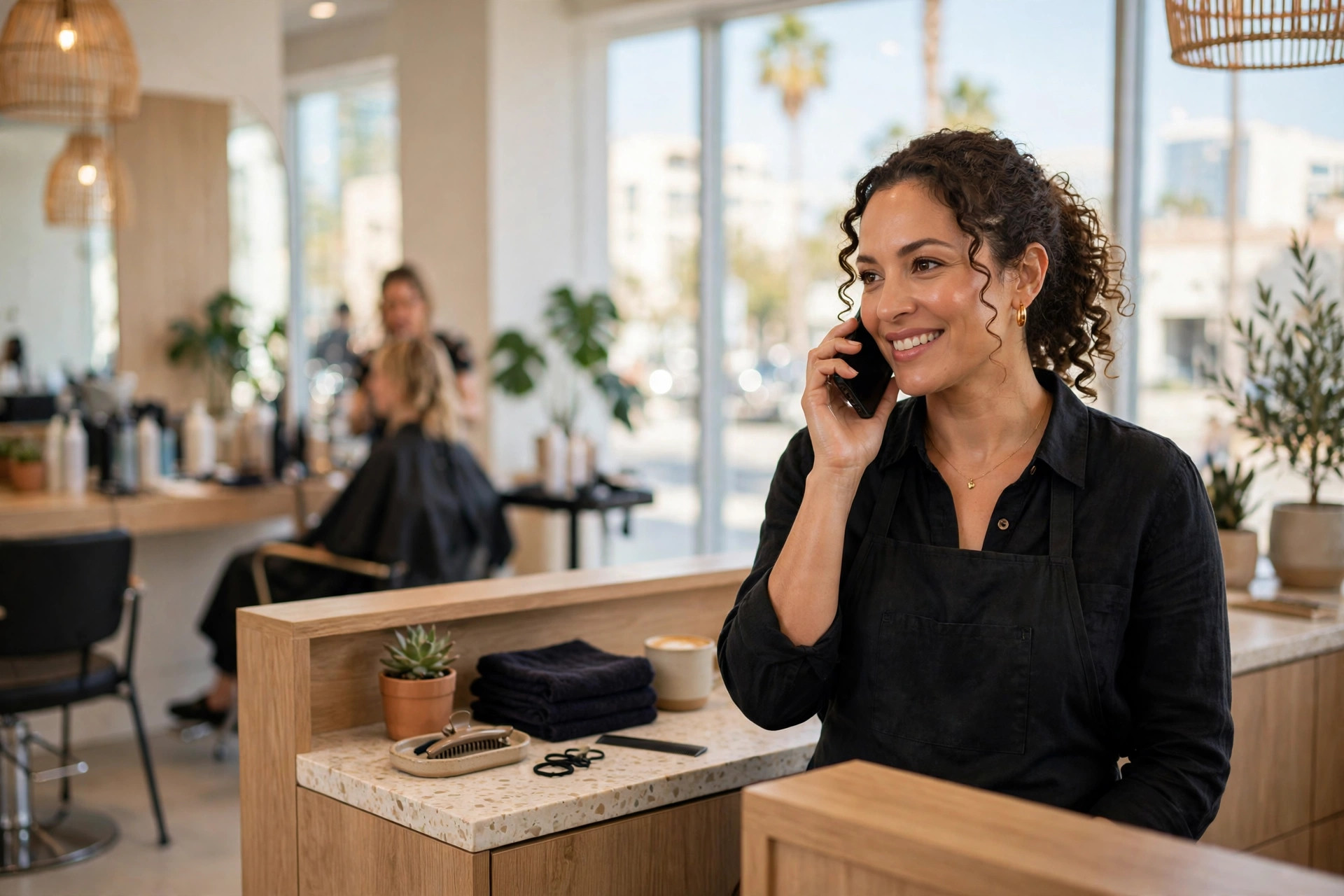
Meet Mariana — and the Monday her salon lost three bookings
Mariana runs a twelve-chair hair salon on Cesar Chavez Avenue in Boyle Heights, East Los Angeles. Saturdays are her money day — colour, balayage, bridal parties. Mondays are admin day: she is doing inventory, her two receptionists are off, and the phone rings while she has foils in her hands.
One Monday in October she counted: eleven missed calls between 10 a.m. and 2 p.m. Four were in Spanish — two voicemails were just silence and a hang-up. One was a woman asking, in Spanish, whether the salon did quinceañera hair for Saturday. That booking alone would have been $180, and a quinceañera party books four or five chairs at once.
Mariana is not unusual — she is the average Los Angeles salon owner. In Los Angeles County, about 3.5 million residents (39.5% of the county) speak Spanish at home, per the U.S. Census Bureau's American Community Survey 2025; across the United States, 44.9 million residents spoke Spanish at home in 2024. When your phone only works in English, you are missing a third of your market — and it never shows in any report, because a caller who hangs up never becomes a no-show or a complaint. They simply never appear.
This piece answers Mariana's question: can an AI receptionist actually answer calls in Spanish — the whole call, booking included — and how do you tell a real one from a translated greeting?
The short answer: yes, and the technology crossed the line in 2026
A modern AI receptionist is a voice agent on your phone number. It picks up, works out which language the caller is speaking, and runs the whole call in that language: answering questions, booking the appointment, texting a confirmation, taking a message, or transferring to a person.
What changed is language detection. The old way was a phone menu: "Press 1 for English, 2 for Spanish." The new way is automatic — the agent listens to the first sentence, answers in that language, and follows the caller if they switch halfway through, for example when a caller hands the phone to a relative. JustCall's AI Voice Agent auto-detects 10 languages and follows mid-call switches; Yobi's setup is two steps (turn on multilingual, add one instruction line); Sonant's remembers each client's language preference, so the next call opens in Spanish automatically.
But vendors use the same words for very different products. "Bilingual" on a pricing page can mean any of three things, and only one of them books Mariana's quinceañera party.
The three things "bilingual" can mean (only one books the appointment)
1. A translated greeting, then voicemail. A phone menu with a Spanish recording asks the caller to press a key, plays a greeting, and sends them to voicemail. It answers no questions and books nothing. It is the cheapest option and the most common disappointment — and probably what a vendor is selling if they cannot show you a Spanish call ending in a booked appointment.
2. A separate Spanish line. Each language gets its own agent and number. It works — FieldCamp builds it this way deliberately — but you publish two numbers, and a caller who switches language mid-call gets stuck. For a salon with one number on Google, Yelp, and Instagram, two numbers is a real cost.
3. One number, automatic detection, full conversation. The agent detects the language in the first sentence, runs the whole call in that language, switches mid-call if the caller does, and writes the summary back in your language. Rosie, Upfirst, and Skipcalls do this on one number; Smith.ai detects Spanish on its AI plans; DeskBuddy runs a separate fluent script per language instead of translating English scripts on the fly. This is the version that books appointments — and the version to buy.
Mariana's test is simple: call the demo line, speak Spanish from the first word, and ask for a Saturday colour appointment for two. Do it twice — once all-Spanish, once switching to Spanish halfway. Pass both and it is a real bilingual receptionist; ask you to press 2 and it is selling you a menu.
Seven questions that separate a real bilingual receptionist from a translated greeting
JustCall's October 2026 guide frames this as seven questions. Here they are, rewritten for a salon owner:
1. Does it detect the language, or does the caller have to choose? Automatic detection from the first sentence is the standard now; a "press 2 for Spanish" menu is a 2015 answer. Callers who are driving, holding a child, or nervous about their English will not navigate a menu — they will hang up.
2. Does it switch languages mid-call? A caller who switches to Spanish — or hands the phone to someone — must not have to start over. Ask the vendor to demonstrate a mid-call switch live, not in a slide.
3. Does it book, or does it take a message? A bilingual receptionist that only takes messages in Spanish is a bilingual voicemail. The booking must happen in Spanish, on your real calendar, with service, stylist, and time confirmed and texted to the caller.
4. What does your team read afterwards? The summary must come back in your language. JustCall translates transcripts to English (beta); Aibrify's Desk sends the owner a summary in the owner's language no matter what the caller spoke. If your team must read Spanish transcripts to find what was booked, the system moved the work, not removed it.
5. Which Spanish? Spain Spanish and Latin American Spanish are different products in the better tools — JustCall lists them as separate agent languages, with voice libraries filtered by accent. A salon in Boyle Heights needs Latin American Spanish, not a Castilian voice. Ask which accent the demo uses.
6. What does Spanish add to the bill? On most tools below, Spanish costs nothing extra — it is included on every plan. A bilingual surcharge is a pricing choice, not a technology cost. Know it before you sign.
7. What does it refuse to do? A good receptionist knows its limits: no medical or legal advice, no prices or policies outside your approved script. Aibrify lets owners list topics the agent will not answer in any language. For a salon: no discounts it was not told about, no medical claims, and any upset client goes straight to a human.
If a vendor answers all seven clearly, in writing, it is a real product. Vague answers mean a translated greeting with a sales page.
The priced comparison: what a Los Angeles salon actually pays
Prices below are published or best-reported figures as of November 2026, excluding taxes. Spanish is included on every plan listed.
| Tool | Entry price | How Spanish works | Best for |
|---|---|---|---|
| Skipcalls | $19.99/mo | Detects the caller's language and switches, same number; English and Spanish | Cheapest honest entry point |
| Upfirst | $24.95/mo | Switches automatically on one number; 35+ languages; transcript translated into yours | Small salons that want set-and-forget |
| Dialzara | $29/mo | English and Spanish on the same number | Lowest flat monthly price with a named vendor |
| Rosie | $49/mo for 250 min | English and Spanish on every call, same number | Salons that want per-minute simplicity |
| Smith.ai | Free AI plan (25 calls/mo); paid AI from $150/mo | Bilingual answering on AI plans; detects Spanish; live North American agents for hard calls | Salons that want an AI + human hybrid |
| JustCall AI Voice Agent | Team $29/user/mo annual (2-license minimum) + per-minute agent | Auto-detects 10 languages, or pin Spain or Latin America Spanish; follows mid-call switches | Teams that already use JustCall as a phone system |
| Talos Connect | $149/mo incl. 500 min | English, Spanish, and Vietnamese | Texas-style volume at a flat price |
| TopWebLA (LA done-for-you) | $497 setup; $149/$249/$399/mo by volume | English or Spanish, rings your phone first, picks up after ~20 seconds | LA salons that want it installed, not configured |
| DeskBuddy | Quoted on demo | Native English, Spanish, and Chinese; separate fluent script per language, not on-the-fly translation | Salons, spas, and gyms that live on bookings |
| VisionQuantech AI Receptionist | $99 founding setup + $25/mo maintenance (first 3 clients, lifetime-locked); then rate card $2,500–$12,500 | Installed for you on your number: Spanish + English detection, booking on your real calendar, summary in your language, human handoff | Salons that want it built and installed, not another tool to learn |
Read the table the way Mariana should: the cheapest sticker is not the cheapest system. Skipcalls at $19.99 a month is the cheapest true bilingual AI receptionist, but it is self-serve — Mariana configures it herself. Smith.ai at $150 a month looks expensive until you notice it is the only tool here pairing its AI with live human receptionists. TopWebLA at $149 a month is the honest LA comparison: done-for-you bilingual help, $497 setup, against a human bilingual answering service at $330–$650 a month. The VisionQuantech row is different in kind — an installed-for-you service, not a self-serve tool. The setup fee buys the build (services, prices, stylists, calendar wired in, in both languages); the monthly care is the running cost. The $99 founding offer applies to the first 3 clients only, then the public rate card applies.
The maths Mariana did on a Monday
DeskBuddy's salon worked example fits Mariana exactly. Say a busy salon misses just three Spanish-speaking callers a week. If each new client is worth $80 a visit and comes once a month, that is 3 × 4 weeks = 12 lost new clients a month, and 12 × $80 × 12 months = $11,520 in lost revenue a year. That is the cost of the English-only phone.
Mariana's own Monday count was four Spanish-speaking missed calls in four hours. Even at half DeskBuddy's rate — six lost clients a month, $60 a ticket — that is $4,320 a year walking down the street. The cheapest real bilingual receptionist above costs $240 a year; the priciest done-for-you option about $1,800 a year plus setup. The gap between the tool and the missed calls is the whole business case, and it fits on an index card.
A second number: a bilingual receptionist on your own payroll in a major US metro typically earns $18 to $22 an hour — $37,000 to $46,000 a year before benefits (DeskBuddy, 2026). A bilingual human answering service runs $330 to $650 a month. An AI receptionist that answers in Spanish starts at $19.99 a month. The AI is not competing with the human on warmth. It is competing on the hours nobody covers — lunch, Mondays, Saturdays at 7 p.m., the four hours Mariana spends with foils in her hands.
Step-by-step: getting a bilingual receptionist live in one week
Step 1 — Count your Spanish calls for three days. Before you buy anything, put a tally sheet by the phone: every missed call, every call where someone struggled in English, every voicemail in Spanish. Mariana found four in four hours. Most LA salons find the same.
Step 2 — Write the ten sentences your phone must handle in Spanish. Not a script — ten sentences: your hours, address and parking, colour prices, cancellation policy, how far ahead Saturdays book out, and what to say when a caller asks for a stylist who left. Get them translated properly — Boyle Heights needs Latin American Spanish, and a bad translation books the wrong service.
Step 3 — Pick the shape, not the vendor. One number with automatic detection, or a separate Spanish line? For a salon with one number everywhere, one number with detection is almost always right. Decide before you look at pricing pages, or they will decide for you.
Step 4 — Run the live test. Call the vendor's demo line. Speak Spanish from the first word and book a Saturday colour appointment for two. Then call again, start in English, switch to Spanish halfway, and ask to change the booking. If both end in a correct booking and summary, the product is real. If either ends in voicemail, a menu, or a confused transfer, walk away.
Step 5 — Launch on overflow first. Do not hand the AI your whole phone on day one. Start with the hours nobody covers — lunch, Mondays, after 7 p.m., Saturdays when the chairs are full. Run it 30 days and judge it on one number: booked appointments that would otherwise have been missed calls. If the number is real, expand it. If not, you lost a month of overflow coverage, not your front desk.
What it cannot do — the honest limits
A bilingual AI receptionist is a front desk, not a person, and the honest vendors say so. On G2, Smith.ai's AI Receptionist scores 4.8 out of 5 across 33 reviews, but reviewers report the same small failures: missed email addresses, misspelled customer names, and a small number of callers put off the moment they realise they are talking to an AI. On Trustpilot, Smith.ai scores 4.2 out of 5 across 376 reviews, with low-star reviews describing trouble cancelling and a dispute over a prepaid plan. Frontdesk AI's low-star reviewers describe refund denials under annual contracts; Dialzara's single 1-star review is about slow support. None of these are reasons not to buy — but buy month-to-month first, test email capture on your own calls, and read the cancellation clause first.
There are also hard limits, and they matter most in California. California is a two-party-consent state: if calls are recorded, your AI must say so, in the caller's language — TelAI's LA law-firm setup builds this in. Healthcare has its own rules: a clinic covered by Section 1557 of the Affordable Care Act has specific language-access duties, and an AI front desk does not replace a qualified medical interpreter. Disclosure is now law in Europe (EU AI Act, Article 50, in force August 2026), and California's B.O.T. Act has required it for years. The right move is the same everywhere: a brief first-sentence disclosure — "Hi, I'm the salon's automated assistant" — in the caller's language, plus an always-available human handoff. In Twilio's 2025 survey, 78% of consumers said being able to switch from AI to a human was important. Give them the switch before they ask for it.
One salon-specific limit: the AI books what you told it to book. If your colour prices changed, your cancellation policy changed, or a stylist left, and nobody updated the AI, it will confidently book the wrong thing in perfect Spanish. Put the update in the same weekly routine as the inventory count.
The verdict for a Los Angeles salon
Can an AI receptionist answer calls in Spanish? Yes — the whole call, booking included, on one number, switching languages mid-call, with the summary back in your language. The products that do it start at $19.99 a month; done-for-you LA options run $149 to $399 a month, against $330 to $650 for a human answering service and $37,000-plus for a hire.
The question is not whether the technology works, but whether the vendor sells a receptionist or a translated greeting. Run the two-call live test, ask the seven questions, launch on overflow, and judge it on booked appointments after 30 days. Mariana's quinceañera party — four chairs, $180, a Saturday — is still out there, calling salons that answer in her language. (For the other half of the salon phone problem — clients who book and then don't show — see the empty-chair maths of salon no-shows.) Make sure one of them is yours.
Can an AI receptionist answer calls in Spanish?
Yes. A modern AI receptionist detects the caller's language from the first sentence and runs the whole call in Spanish — answering questions, booking appointments, texting confirmations, and taking messages. The best systems also switch languages mid-call and write the summary back in your language. Beware of products that only play a Spanish greeting and send the caller to voicemail.
Does a bilingual AI receptionist cost extra?
Usually not. On most tools — Rosie, Upfirst, Skipcalls, Smith.ai, JustCall, Dialzara — Spanish is included on every plan at no extra charge. A bilingual human answering service typically costs $330–$650 a month, and a bilingual receptionist hire costs $37,000–$46,000 a year before benefits, so the AI is the cheapest bilingual option by a wide margin.
Can it book appointments in Spanish, or just take messages?
A real bilingual receptionist books in Spanish on your real calendar — service, stylist, time, and confirmation text included. If a vendor's Spanish handling ends in a message or a callback request, it is a bilingual voicemail, not a bilingual receptionist. Test this with a live Spanish booking call before you pay.
What if a caller switches from English to Spanish halfway through?
The better systems follow the switch without restarting the call — JustCall auto-detects 10 languages and follows mid-call changes; Yobi switches on a one-line instruction; Sonant remembers the caller's language preference for next time. Always test a mid-call switch on the vendor's demo line before buying.
Do I have to tell callers they are talking to an AI?
Yes — and you should want to. California's B.O.T. Act requires disclosure, the EU AI Act (Article 50, in force August 2026) requires it, and 78% of consumers in Twilio's 2025 survey said being able to switch from AI to a human was important. A brief first-sentence disclosure in the caller's language, plus an always-available human handoff, is the standard.
Is a bilingual AI receptionist right for a small salon in Los Angeles?
If a real share of your callers speak Spanish, yes — and in Los Angeles County that share is about 39.5% of residents. A salon missing three Spanish-speaking callers a week at an $80 average ticket loses about $11,520 a year in new-client revenue. Start on overflow hours (lunch, Mondays, after 7 p.m.), judge it on booked appointments after 30 days, and expand from there.
References & further reading
- JustCall — "Bilingual AI Receptionist: How It Works and 8 Tools Compared" (Oct 2026). https://justcall.io/blog/bilingual-ai-receptionist.html
- U.S. Census Bureau, American Community Survey 2025, table B16001 — Spanish spoken at home in Los Angeles County (3,455,147 speakers, 39.5%), via LA Almanac / Access Multilingual. https://www.laalmanac.com/population/po48s.php
- U.S. Census Bureau, American Community Survey 2024, table C16001 — Los Angeles–Long Beach–Anaheim metro, 34.4% speak Spanish at home, via Botcadence. https://www.botcadence.com/blogs/spanish-hvac-answering-service
- Smith.ai — "Bilingual Virtual Receptionist for Spanish-Speaking Clients". https://Smith.ai/blog/how-to-choose-a-virtual-receptionist-with-bilingual-support-for-your-company
- FieldCamp — "Best Bilingual AI Receptionists and Answering Services (2026)". https://fieldcamp.ai/answering-service/best-bilingual/
- ToolsGavel — "Best AI Phone Receptionists for Small Business" (prices and review scores verified 12 Nov 2026). https://toolsgavel.com/best/best-ai-phone-receptionists-small-business/
- G2 — Smith.ai AI Receptionist reviews (4.8/5, 33 reviews). https://www.g2.com/products/smith-ai-ai-receptionist/reviews
- DeskBuddy / TRTC — "Multilingual AI Receptionist for Small Business". https://trtc.io/blog/details/multilingual-ai-receptionist
- TopWebLA — "Bilingual AI Phone Assistant for LA Small Businesses". https://www.topwebla.com/ai-phone-assistant-los-angeles
- TelAI — "How We Set Up a Bilingual AI Line in 48 Hours". https://www.telaiagent.com/blog/how-we-set-up-a-bilingual-ai-line-in-48-hours-behind-the-scenes
Cite this article: Shivam Kumar (2026). Can an AI Receptionist Answer Calls in Spanish? VisionQuantech. https://visionquantech.com/blog/can-ai-receptionist-answer-calls-in-spanish-los-angeles-salons.html
Want a bilingual AI receptionist for your salon — set up live on a 15-minute call?
VisionQuantech installs AI receptionists for salons, clinics, home services and real estate: $99 setup and $25 a month, lifetime-locked, for the first 3 customers. Your phone answers in English and Spanish from day one.
Book Your 15-Min Live Setup