TL;DR: Yes — the day your leads arrive from more than one source, or two people share the follow-ups. A spreadsheet works while one person handles a few enquiries a day. After that, leads go cold because nobody called back: firms that reply within an hour are seven times more likely to qualify a lead (Harvard Business Review, 2011). The trap is pricing: per-seat plans charge ₹12,500 a month for five agents.
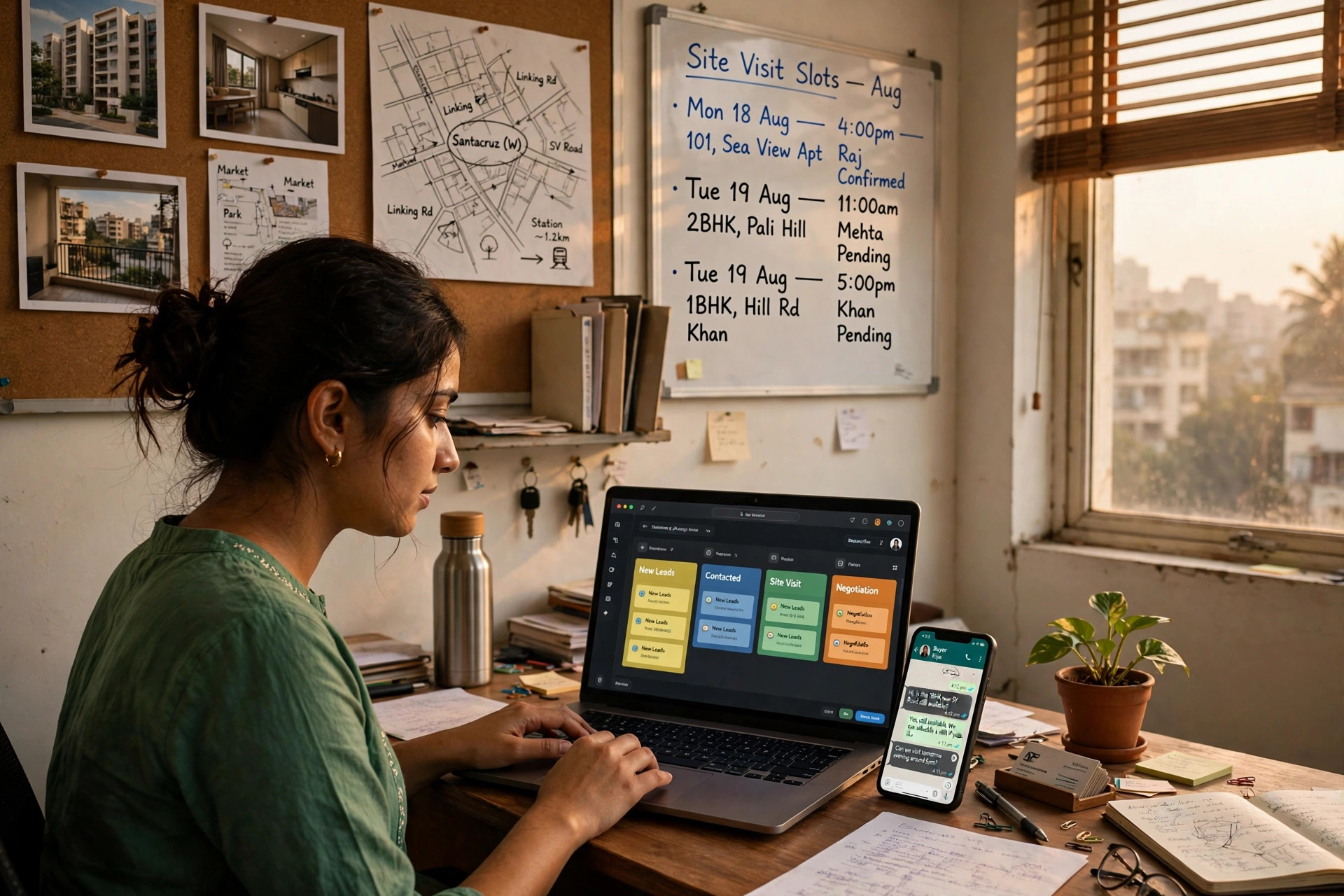
Meet Raj — and his five-agent brokerage in Santacruz West
Raj runs a five-agent brokerage off Linking Road in Santacruz West, selling flats in Pali Hill and Hill Road. His leads arrive from everywhere: 99acres and MagicBricks, Meta ads, Google calls, walk-ins, WhatsApp on four agents' phones.
Every morning the same scene: sixty new enquiries in a shared Google Sheet, names forwarded on WhatsApp, two agents calling the same buyer with two different prices — and a Saturday site visit nobody records, so Monday's call starts from zero.
Raj's numbers are ordinary: about 120 leads a month, and about 40 never get a call back. Not because his agents are lazy — because the lead is sitting in someone's WhatsApp, not in a system. This guide answers it with a five-question test, the priced comparison, and a seven-day test.
The five-question break-point test
A CRM is not a status symbol — it is a tool for a specific break-point. Answer these five questions honestly.
Question 1: Do leads arrive from more than one source? One channel — walk-ins and phone calls only — and a notebook works. Two or more, and you have a routing problem: which lead came from where, and who owns it? Veloxis Global's 2026 guide agrees: a shared sheet is enough for one or two people.
Question 2: Do more than two people follow up? The moment a third person touches the same lead list, the spreadsheet breaks: two agents call the same buyer, and nobody can say who spoke to them last. A CRM gives every lead one owner and one next action with a date.
Question 3: Can you say which campaign produced last month's bookings? Raj spends on Meta ads and portal listings every month. If he cannot say which source produced last month's bookings, he is buying leads blind. A CRM tags every lead with its source.
Question 4: Do leads go cold because nobody called back? Harvard Business Review (2011) found firms that reply within an hour are about seven times more likely to qualify a lead than firms that wait. In property, the buyer enquires with five brokers at once — the first proper call-back gets the site visit.
Question 5: Do leads leave when a person leaves? In Indian brokerages, agents change firms often and the client relationship lives on the agent's personal phone. When one walks out with fifty warm contacts, months of work walk out with them. A CRM keeps the history with the company — and under India's DPDP Rules (November 2025, penalties up to ₹250 crore), keeping buyer consent and records in one governed system is a legal duty.
One yes: the spreadsheet still works. Two or more: you have outgrown it.
What a CRM actually does for a small Indian brokerage
A good real-estate CRM is not a bigger spreadsheet. It does six jobs a spreadsheet cannot.
Job 1: Catch every lead at the source. Enquiries from 99acres, MagicBricks, Housing.com, Meta and Google forms, missed calls and walk-ins land in one list automatically, with the source attached. Nobody retypes anything.
Job 2: Assign in seconds, with a rule. The lead is routed by project and location the moment it arrives — a Pali Hill 2 BHK enquiry goes to the agent who knows Pali Hill.
Job 3: Run the follow-up so nobody has to remember it. The buyer who does not reply gets a short sequence — a WhatsApp nudge, a call, a matching new listing — and if there is still no answer after five or six days, the lead is marked lost with a reason. That lost-reason log is gold: if most lost deals say "budget", your ads target the wrong people. (An AI chatbot for real estate agents can run the first two steps.)
Job 4: Track the site visit, not just the call. In Indian property, the site visit is the sale. The CRM books it, assigns the agent, sends a WhatsApp confirmation, and records what the buyer liked — so Monday's call does not start from zero.
Job 5: Hold the inventory. For brokers handling developer stock, the CRM tracks which units are available, on hold or blocked.
Job 6: Show the owner what is actually happening. Response times, conversion per agent, lost reasons, commission — one screen. An owner who sees one agent convert one in ten visits and another one in three can coach the first.
Storing contacts is not on the list. A CRM earns its money on jobs two, three and four.
The priced comparison: what a five-agent Santacruz brokerage actually pays
Prices below are published or best-reported figures as of November 2026, for a five-agent brokerage getting about 120 leads a month, excluding 18% GST.
| Platform | Sticker price | What five agents actually pay | Implementation | Best for |
|---|---|---|---|---|
| Sell.do | From ₹2,599/user/mo; Enterprise Suite ₹34,990/mo for 10 users | ₹12,995/mo (₹1,55,940/yr) | Quote-based, scoped per project; G2 benchmark 1 month to implement | Large developers, single-project launches |
| LeadSquared | Lite ₹1,250; Pro ₹2,500; Super ₹5,000/user/mo | ₹12,500/mo Pro (₹1,50,000/yr) | One reviewer paid ₹1.5 lakh for implementation + 6-month licence; another reported 6 months to go live | High-volume telecalling teams |
| Zoho CRM | Standard ₹800; Professional ₹1,400; Enterprise ₹2,400/user/mo | ₹7,000/mo Professional (₹84,000/yr) | ₹80,000–₹2.5 lakh for a proper real-estate setup | Agencies with an admin to configure it |
| Kylas | ₹12,999/mo flat, unlimited agents | ₹12,999/mo (₹1,55,988/yr) | Included in flat price | Growing brokerages, 12+ agents |
| TeleCRM | ₹599/user/mo; ₹749 with WhatsApp sync | ₹3,745/mo with WhatsApp (₹44,940/yr) | Self-serve | Calling-heavy small teams |
| TatvaCRM | From ₹449/user/mo | ₹2,245/mo (₹26,940/yr) | Self-serve | Brokers wanting India pricing |
| Privyr | Free for up to 3 members | Free for 3; paid above that | Self-serve | Solo agents on mobile |
| VisionQuantech Real-Estate CRM | ₹2,499/mo flat, whole team | ₹2,499/mo (₹29,988/yr) | ₹14,999 one-time, done-for-you setup | Small brokerages that want flat pricing |
At five agents, LeadSquared Pro costs ₹12,500 a month and Sell.do about ₹12,995 — five times the flat ₹2,499. Over three years, LeadSquared Pro costs ₹4,50,000 before GST and before implementation; the flat system costs ₹1,04,963 all-in. Hire three more agents and LeadSquared Pro jumps to ₹20,000 a month.
LeadSquared's marketing automation is a separate product — ₹90,000 a year for Marketing Pro, ₹1,49,000 for Super, each covering only two users. WhatsApp is an add-on or a credit pack on most platforms — ask every vendor before the demo ends whether it is included in the sticker price.
What the reviews actually say
The review pages are where the per-seat story falls apart. LeadSquared's Sales CRM holds 4.5 out of 5 on G2 from 284 reviews, but the complaints repeat three themes: slow loading is the most repeated; the dated experience — one reviewer writes the software "feels like it was built a decade ago... A task that should take one click takes ten"; and price creep. On Trustpilot, four reviews average 2.6 out of 5.
The implementation story is the one to take seriously. One G2 reviewer reports paying ₹1.5 lakh — roughly ₹50,000–₹60,000 as implementation fee and the rest for a six-month licence — for a product that was "unworkable for our team"; the refund request got "a flat no". Another reviewer reported a six-month implementation.
Sell.do's own guide is honest about the other side: pricing is custom "because deployments are scoped to your projects and team", and it is built for large developers. Neither product is bad software — Sell.do scores 4.8 out of 5 on G2 from 129 reviews, and LeadSquared's lead management is praised in 36 G2 mentions. The question is fit, not quality.
The staged system: spreadsheet to flat price in four steps
A small brokerage does not need to buy a CRM on day one — the cheapest path is staged, each stage with a clear break-point.
Step 1: A shared sheet + WhatsApp (1–2 people, one source, under 30 leads a month). A Google Sheet with columns for name, number, source, budget, next action and date costs nothing — until the second person opens it and the first duplicate call happens.
Step 2: A free tier (testing the workflow). Privyr is free for up to three members; Zoho CRM is free for three users. Use the free tier to learn what your team actually updates every day — if nobody updates the free CRM, nobody will update the paid one.
Step 3: A per-seat tool for a calling-heavy team (3–5 agents, one job). TeleCRM at ₹599 a user a month, or ₹749 with WhatsApp sync, is the cheapest honest per-seat option for a calling-heavy team; TatvaCRM from ₹449 a user does the same with India pricing. At eight agents, TeleCRM with WhatsApp costs ₹5,992 a month and keeps rising.
Step 4: A flat monthly system (5+ agents, two or more sources, or the first agent who leaves with the contacts). This is where Raj is now. At 120 leads a month from five sources, the sheet costs him about 40 uncalled leads a month. A flat ₹2,499 a month buys the capture, the routing, the follow-ups, the site visits and the source reporting — WhatsApp included, no per-seat meter.
The seven-day test — run it before you buy anything
Do not switch on a demo. Run this test for one week, and let the numbers decide.
Day 1: Count your real volume. How many leads arrived this week, from which sources, and how many got a call back within an hour? Raj's numbers — 120 a month, 40 never called — are the inputs.
Day 2: Time the first response. Take ten leads from yesterday and check when each got its first real call. Over an hour on average, and you are losing the race.
Day 3: Price the same month three ways. Take last month's real team size and price it three ways — the sticker (₹2,500 a user), the loaded cost (subscription plus WhatsApp credits plus implementation), and a flat ₹2,499.
Day 4: Ask who owns the contacts. If your best agent left tomorrow, how many warm buyers would leave with them? More than ten, and your client list is a loan.
Day 5: Check the export button. Ask each vendor to show you a one-click export of your full lead list, live, without a support ticket. If they cannot, you are renting your own leads.
Day 6: Read the data clause. Who owns the records, where are they stored, and what happens under the DPDP Rules if the vendor is breached?
Day 7: Decide on the maths, not the demo. If two or more break-point questions are yes and your loaded per-seat cost is above ₹3,000 a month, a flat ₹2,499 system is the cheapest way to keep the leads and the follow-ups.
The verdict, by team size
Solo agent, under 30 leads a month, one source: a shared sheet, or Privyr free for up to three members. Never sign a yearly contract before you outgrow the free tier.
Two to four agents, one or two sources (Raj two years ago): a free tier first, then TeleCRM at ₹599 a user or TatvaCRM from ₹449 — the cheapest honest per-seat options.
Five to ten agents, three or more sources (Raj today): a flat ₹2,499-a-month system. LeadSquared Pro at five agents costs ₹12,500 a month, Sell.do about ₹12,995, Kylas ₹12,999 — all three rise with every hire.
Ten-plus agents, launch-scale volume: Sell.do or LeadSquared earn their price here — live inventory, cost sheets and channel-partner payouts are built for developers running launches. Pay for the depth only when the volume needs it.
A brokerage that lives on WhatsApp: whichever system you pick, WhatsApp follow-up must be included in the price, not sold as credits — see how a WhatsApp AI agent for real estate handles the first reply.
Raj picked the flat ₹2,499 system: his leads come from five sources, and his next hire should not raise his software bill. The switch took a week: export the sheet, import the leads, connect 99acres and the Meta forms, set the follow-up rule — every lead gets one owner, one next step, one date.
Frequently asked questions
Do small real estate agencies need a CRM?
Yes, once leads arrive from more than one source or more than two people follow up. A spreadsheet works while one person handles a few enquiries a day. After that, leads go cold — firms that reply within an hour are about seven times more likely to qualify a lead (HBR, 2011).
What is the best CRM for a small real estate agency in India?
It depends on team size. Solo agent: Privyr (free up to 3 members) or Zoho CRM's free tier. Calling-heavy team of 3–5: TeleCRM (₹599/user/month) or TatvaCRM (₹449/user/month). A 5–10 agent brokerage: VisionQuantech Real-Estate CRM at ₹2,499 a month.
How much does real estate CRM software cost in India?
From free (Privyr, Zoho free tier) to ₹449–₹2,500 per user per month (TatvaCRM, LeadSquared Pro, Sell.do), to ₹12,999 a month flat (Kylas), plus implementation — Zoho setups run ₹80,000–₹2.5 lakh. A flat ₹2,499-a-month system is the cheapest honest price.
Can I use a spreadsheet instead of a CRM?
Yes — while one or two people handle a few enquiries a day from one source. It breaks the day a second person edits the same list, or an agent leaves with the contacts on their phone.
What is the cheapest real estate CRM for a five-agent team in India?
A flat system: VisionQuantech Real-Estate CRM at ₹2,499 a month for the whole team (₹14,999 one-time setup). The cheapest per-seat options are TatvaCRM from ₹449 a user a month (₹2,245 for five agents) and TeleCRM at ₹599 a user (₹3,745 with WhatsApp sync). LeadSquared Pro for five agents costs ₹12,500 a month — five times the flat price.
What does VisionQuantech Real-Estate CRM cost, and what is included?
₹14,999 one-time setup plus ₹2,499 a month, flat, for the whole team, installed for you on request. Lead capture from 99acres, MagicBricks, Facebook and Google; inventory with hold/block and cost sheets; site-visit scheduling with WhatsApp confirmations; channel-partner logins with payout tracking; and follow-up automation with dead-lead reactivation. No per-seat fee, no per-lead fee.
References & further reading
- Veloxis Global, Real Estate CRM in India: How to Choose and Set It Up (2026) — break-point test, HBR 2011, DPDP rules: https://www.veloxisglobal.com/blog/real-estate-crm-india
- Prospeo, Sell.Do Pricing, Reviews, Pros & Cons (2026) — Sell.do from ₹2,599/user/month, Enterprise ₹34,990/month for 10 users, G2 4.8/5 (129): https://prospeo.io/s/selldo-pricing-reviews-pros-and-cons
- Prospeo, HubSpot vs LeadSquared: Which CRM Wins in 2026? — LeadSquared Pro ₹2,500/user/month, Super ₹5,000, marketing automation ₹90,000–₹1,49,000/year, G2 4.5/5 (284): https://prospeo.io/s/hubspot-vs-leadsquared
- NeerSoft, Top 5 CRMs for Real Estate Agents in India — Zoho ₹800/₹1,400/₹2,400 per user/month; Kylas ₹12,999/month flat; implementation ₹80,000–₹2.5 lakh: https://neersoft.com/best-crm-real-estate-india/
- Autometa, Best CRM for Real Estate Agents in 2026: India and Global — TeleCRM ₹599/user/month (₹749 with WhatsApp), Privyr free up to 3 members, DPDP Rules November 2025: https://www.autometa.in/blog/best-crm-for-real-estate-agents
- TatvaCRM, Best CRM for Real Estate in India (2026) — TatvaCRM from ₹449/user/month; Sell.do and LeadSquared for large developers: https://tatvacrm.com/resources/best-crm-for-real-estate-india
- Sell.do, Best Real Estate CRM Software in India (2026) — real-estate-native workflows, IRIS launches, 1,000+ developers and agencies: https://www.sell.do/blog/top-crm-software-for-real-estate-developers-in-india
- 99salescrm, CRM for Real Estate Agents in India: How to Track Leads — one record, one owner, one next step; the 60-lead Tuesday scene: https://99salescrm.com/crm-for-real-estate-agents-in-india-how-to-track-leads/
- SparrowCRM, 10 Best CRM Software in India 2026 — LeadSquared Lite ₹1,250 / Pro ₹2,500 / Super ₹5,000 per user/month: https://www.sparrowcrm.com/blogs/best-crm-software-in-india
Cite this article: Shivam Kumar (2026). Do Small Real Estate Agencies Need a CRM? VisionQuantech. https://visionquantech.com/blog/do-small-real-estate-agencies-need-a-crm-santacruz-west-mumbai.html