TL;DR: A Borivali gym with 180 members bills ₹3,24,000 a month and collects only about 65% of it on time — a leak of ₹1,13,400 a month, or ₹13.6 lakh a year. Members are not refusing to pay; they are forgetting. The fix is three things: reminders that fire automatically 3 days before expiry, every reminder carrying a one-tap UPI payment link, and UPI autopay for members who opt in. Gyms that automate move overdue-fee recovery from 40–60% to 80–95%.
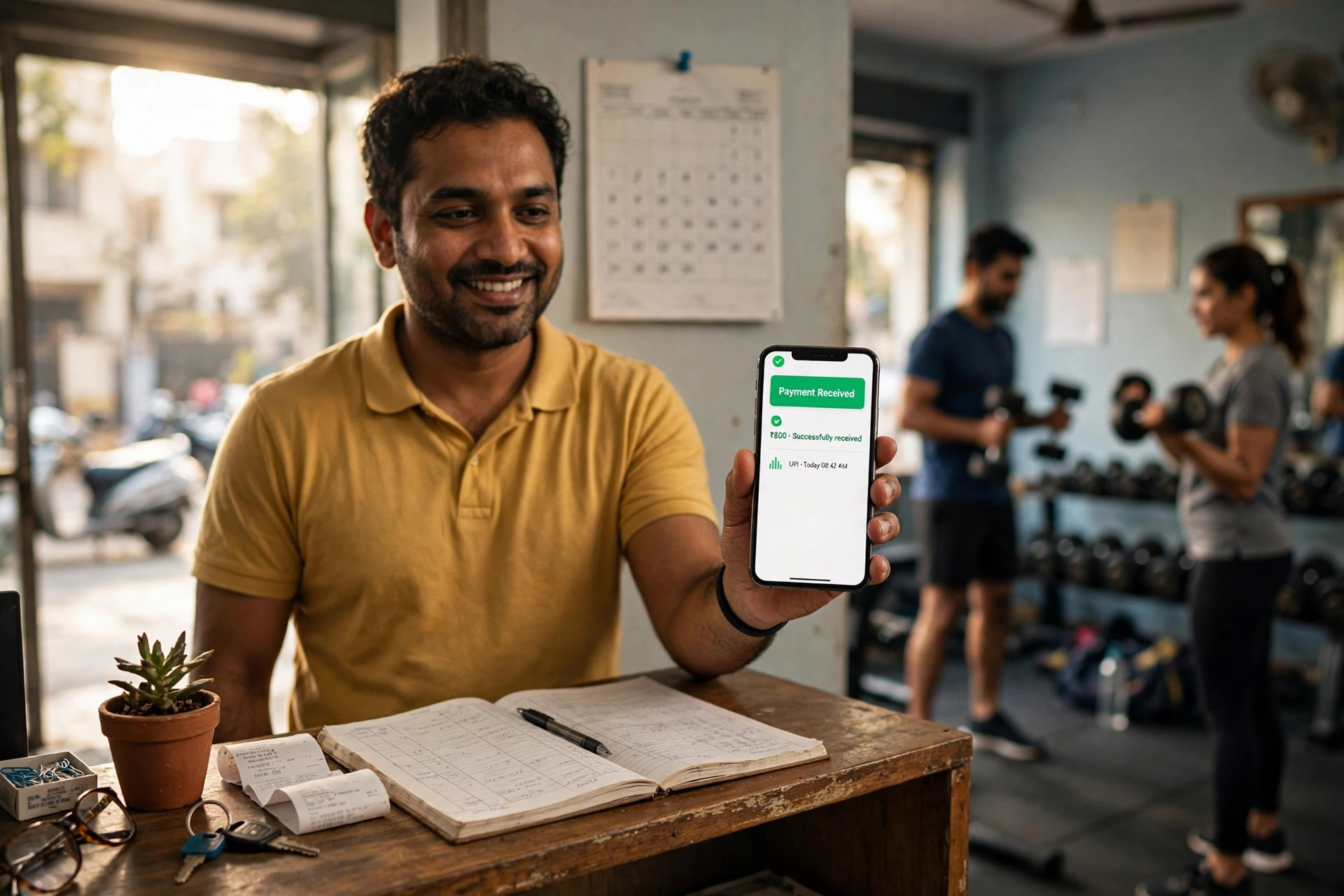
Sanjay's Friday night in Borivali
Sanjay runs a neighbourhood gym in Borivali West, Mumbai, with 180 members and a monthly fee of ₹1,800. (Sanjay is an illustrative example, not a VisionQuantech client.)
Every Friday night, Sanjay sits at the front desk with a register and his phone. He is owed about ₹22,000 from members whose plans expired that week. He makes fifteen calls. Three people promise to pay "tomorrow", two say they will "transfer on Monday", one swears he already paid (he had not), four do not pick up, and five pay on the spot because he caught them. By 9 p.m. he has collected ₹8,000 of the ₹22,000 he was owed. He has spent his evening chasing money he already earned — and he will do it again next Friday.
The leak, in numbers
Start by measuring the leak, because most owners guess it wrong. Ask a gym owner what their collection rate is and most will guess around 80%. Ask them to measure it — count the plans that expired last month against the payments actually received — and the real number usually lands between 55% and 70%.
| Per month | |
|---|---|
| Members billed (180 × ₹1,800) | ₹3,24,000 |
| Collected on time at 65% | ₹2,10,600 |
| Leak — billed but not collected on time | ₹1,13,400 |
| Leak over a year | ₹13,60,800 |
That leak is not members refusing to pay — almost nobody in a gym is deliberately defaulting. The gap is intent that never became a transaction: a plan expired on the 12th, nobody noticed, a message went out on the 19th, the member said "kal kar dunga", tomorrow came, nothing happened. Multiply by 180 members and that is the single largest revenue leak in the business.
Three more numbers frame the stakes. ABC Fitness, drawing on data from 40 million members across 30,000 locations, found that collections issues account for 20.95% of gym cancellations. Manual collection costs 3–4 hours a week for 200 members — 150–200 hours a year, nearly five working weeks. And the recovery gap is stark: on overdue fees, manual chasing recovers 40–60%, while automated collection recovers 80–95% — and members lost to payment friction fall from 15–20% to 5–8%.
Why members don't pay (it's not what you think)
There are only three reasons, and none of them is "they don't want to pay":
1. Members forget. "I'll transfer today." They don't. Another week goes by. The plan expired, the member is still training, and nobody's system noticed.
2. Members dispute. "I transferred yesterday." They didn't — or you can't find the transaction. Money arrives by UPI, the owner writes a receipt or does not, and the member's expiry date does not update. Without a record, every payment becomes an argument.
3. Members go silent. They stop paying and stop replying. You are left chasing ghosts — and every chase costs you the relationship, because asking a friend for money feels awkward on both sides.
Notice what all three have in common: they are system failures, not character failures. A reminder sent by a human gets skipped. A reminder with no payment path produces a conversation, and a conversation produces a promise, and a promise produces nothing. A reminder sent after the plan has already expired arrives when the member has mentally moved on. Fix the system and the members pay.
Step 1: Measure your real collection rate before you buy anything
Never buy software before you know your own number. Take last month: count every plan that expired, add up what those members owed, and divide what you actually received by what was owed. That is your collection rate. If it is under 70%, you have a collection problem, not a pricing problem — and the software in this guide should be judged on whether it moves that one number.
Step 2: Put the reminder on a schedule — and always attach the payment
The single most effective change costs nothing: reminders fire on a schedule, automatically, and every reminder carries a one-tap payment link.
The schedule that works: 3 days before expiry, 1 day before, on the morning of expiry, 1 day after, and 3 days after. The message that prevents the problem is the one sent three days before — the member is still active, still coming in, still happy. The message sent three days after expiry arrives when the member has already decided, quietly, that they have left.
And every message must carry the payment, not just the ask. "Hi, your monthly fee of ₹1,800 is due. Pay now: [UPI link]" — the member taps once, pays through Google Pay, PhonePe, Paytm, or BHIM, and the payment lands in your system instantly, with a receipt going out on its own. Compare that with "Your fee is due": a conversation, a promise, nothing.
Two details matter. First, the reminder must come from the gym's system, not your personal number — from a personal number it feels like asking a friend for money, which is why it gets delayed and skipped. Second, the payment must update the expiry date automatically the moment it lands. If the member record does not move forward when payment arrives, you are back to manual reconciliation and the leak reopens.
Step 3: UPI autopay — the members who never need chasing again
For members who opt in, UPI autopay is the closest thing to a solved problem. The member authorises once — you send a UPI autopay link, the member clicks, enters their UPI PIN, authorises recurring payments — and after that the payment happens automatically on the payment date. You see collected, pending, and failed on a dashboard. Failed payments get one follow-up. The rest, you don't touch.
This works in India because UPI is how the country already pays. NPCI processed 13.4 billion UPI transactions in 2024, worth over ₹200 lakh crore. Meeting members there removes almost all the friction.
Know the rules that govern it, because they shape how you set it up:
- The ₹15,000 ceiling. A UPI autopay debit of up to ₹15,000 executes automatically, with no further authentication. Gym memberships are not on the list for the higher ₹1 lakh threshold (insurance premiums, mutual fund SIPs, credit card bills). A ₹24,000 annual membership cannot be auto-debited in one go — so bill monthly or quarterly if you want autopay to work.
- The 24-hour notice. Every scheduled debit needs a pre-debit notification sent at least 24 hours in advance, carrying the amount, the date, and the mandate reference. Send it on WhatsApp, not SMS — it is the channel your members actually open, and it doubles as a renewal reminder.
- The retry window. A failed payment can be retried up to three times. Used well, that covers the gap between a member's salary date and your billing date. Used badly — nobody configured retries — the payment fails once, nothing happens, and three weeks later somebody notices the member is unpaid.
- The billing date. The 1st is the worst day of the month to bill in India. The 5th or 7th fails far less often — align the debit date with salary dates.
UPI autopay mandates crossed 1.27 billion in November 2025, growing roughly tenfold in under two years. This is now the default way recurring payments get collected in India, and your members are used to it.
Step 4: What to do when a payment still fails
Even with autopay, some payments will fail — insufficient balance on the debit date is the most common reason in India, and it says nothing about whether the member wants to keep training. The playbook:
- Failed autopay: send one reminder — "Your auto-pay didn't go through. Please check your account or re-authorise." One follow-up. The retry window does the rest.
- Member disputes a charge: check the transaction history. If they paid, resolve it. If they didn't, show them the record. Most disputes are genuine misunderstandings — and they disappear once payment updates the record automatically.
- Member goes silent: after two missed follow-ups, stop chasing. Mark them as lapsed and leave the door open.
- Member can't pay right now: consider a payment plan — half now, half next month. Document it and follow up as agreed. A member on a plan is still a member; a member you shamed out the door is a cancellation, and collections issues already drive one in five of those.
Step 5: The door test — expired members should not train for free
Collection has a second half that most guides skip: access. If an expired member can walk past the front desk and train anyway, every reminder in the world is optional. The gyms that collect well block expired members at the door — a QR or biometric check-in that refuses entry when the plan has lapsed, and sends the member a renewal link on the spot.
This is also the test that separates real gym software from a billing spreadsheet. When you demo any tool, ask: does the door know the payment status? If the answer is "the front desk checks the register", you have found the tool's real price — the software fee plus your Friday nights.
The comparison table — what each tool actually does about fees
| Tool | Monthly cost | UPI autopay | WhatsApp reminders with payment link | Blocks expired members at the door | The catch |
|---|---|---|---|---|---|
| VisionQuantech Gym Manager | ₹1,499 flat (₹9,999 setup) | Yes | Yes | Yes (QR/biometric check-in) | Set up on request, not instant self-serve; new product — ask for a live demo first |
| GymForce Lite | ₹2,999/year (~₹250/mo) | Yes | Yes | Yes (eSSL, Timmy, ZKTeco) | No payroll, no group classes; exports payroll to a CA — but for fee collection alone it is the cheapest full answer |
| Okfit | ₹500/mo Lite; ₹2,000 Essential | Yes | Automatic reminders only on the ₹2,000 Essential tier | Yes (Matrix; eSSL X990 partly) | The ₹500 tier is click-to-chat only — the automation you need sits two tiers up |
| IronBook | Free to 25 members; Pro ₹499/mo to 100 | Yes (UPI) | Yes | Yes (face recognition + QR) | Per-member caps: the ₹499 tier stops at 100 members |
| AdviceFit | Free to 25 members; ₹1,500/mo | Not stated | Automatic; own number on Premium | Yes (eSSL, ZKTeco) | Free plan is genuinely free, but WhatsApp from your own number needs Premium |
| Gymdesk | $75/mo (up to 50 members) | No | No (email-based) | Yes (member check-in) | US-dollar pricing, no UPI, no GST invoicing; price climbs as the roster grows |
| Mindbody | From $79/mo per location | No | No (cards + email) | Yes (branded app) | Quote-only tiers above Starter (reported $259–$699/mo); no UPI, no GST; contract lock-in and post-cancellation billing complaints across G2, Trustpilot, and Capterra |
Dollar conversions use roughly ₹88 to the dollar. Prices are published 2026 list prices — verify on the vendor's own pricing page before you buy. Mindbody's higher-tier figures are third-party reported estimates, not published prices.
Three things jump out. First, the global tools are not collection tools in India at all — Mindbody and Gymdesk price in dollars, run on cards, and have no UPI autopay and no GST invoicing. Second, the cheapest Indian answer is GymForce Lite at ₹2,999 a year, and this guide says so plainly — if fee collection is the only job you need done, it is the cheapest full answer on this table. Third, the trap is tiering: Okfit's ₹500 headline price does not include the automatic reminders you are buying it for; those sit on the ₹2,000 tier.
Who wins, and when — the honest verdicts
- GymForce Lite wins when fee collection is the only job and budget decides — ₹2,999 a year flat, UPI autopay, WhatsApp reminders, and biometric door control. It loses when you also need group classes, trainer commission tracking, or payroll in the same system — it says so itself.
- VisionQuantech Gym Manager wins when you want memberships, classes, trainer commission, and payroll summary in one flat-priced system with UPI autopay and WhatsApp built in, and your member count will grow past the capped tiers. It loses on entry price — ₹1,499 a month is six times GymForce Lite — and on self-serve: it is set up on request.
- IronBook wins for a gym under 100 members that wants a free start. It loses past 100 members, where the per-member cap pushes you up a tier.
- Okfit wins on the lowest monthly headline price. It loses on honesty of pricing — the automation sits two tiers above the price it advertises.
- Mindbody wins when you want the consumer marketplace — the 2.8-million-user app that puts your classes in front of people searching for workouts — and you operate internationally. It loses in India: dollar pricing, no UPI, no GST, quote-only tiers, and the review pattern every buyer should read before signing — contract lock-in ("locked in until 2026… keep paying monthly or buy out the rest of the contract"), billing that continued after cancellation requests, and support reviewers describe as slow or unreachable. Its Trustpilot score is 4.4 out of 5 across 2,376 reviews, so the product works for many — but the complaints cluster around money and exit, not features.
- The register and the Friday-night phone marathon win if your gym has twenty members who all pay in cash on the 1st. They lose the week your member count passes a hundred — which, at ₹1,13,400 a month of leak, is every week.
Sanjay's Friday, rewritten
Back in Borivali: the reminders went out on Tuesday, three days before expiry, each carrying a one-tap UPI link. Forty members paid before Sanjay even looked at the register. Sixty-two members are on UPI autopay — their fees debited on the 5th, with the 24-hour WhatsApp notice doubling as a renewal reminder. Three autopays failed on insufficient funds; two landed on the first retry, one got a single WhatsApp nudge and paid. At the door, two expired members were stopped by the QR check-in and renewed on the spot instead of training for free.
Sanjay's Friday night is now a dashboard check, not a phone marathon. His collection rate moved from 65% to over 85% — ten more members of every two hundred keep paying, worth ₹15,000–₹30,000 a month. The question was never whether his members wanted to pay. It was whether his system let them.
Related reading: VisionQuantech AI services, how much gym staff scheduling and payroll software costs in India, and the Gym CRM showcase.
Frequently asked questions
How do I collect gym membership fees on time without chasing members? Automate three things: reminders on a schedule (3 days before, 1 day before, on the day, 1 day after, 3 days after expiry), every reminder carrying a one-tap UPI payment link, and UPI autopay for members who opt in. Automated overdue-fee recovery runs 80–95%, versus 40–60% manual.
What is a good collection rate for a gym? Most owners guess around 80%, but measured honestly the real rate for manual collection lands between 55% and 70%. Above 85% is good and achievable with scheduled reminders, UPI payment links, and autopay.
What is UPI autopay and how does it work for gyms? A UPI autopay mandate is standing permission from a member to debit their bank account on a schedule. The member authorises once with their UPI PIN; after that the fee debits automatically. Debits up to ₹15,000 need no further authentication, every debit needs a pre-debit notice at least 24 hours in advance, and a failed payment can be retried up to three times.
Why do gym members not pay on time? Almost never refusal. The three real reasons are forgetting, disputes over whether a payment was made (no record), and going silent after awkward manual chasing. All three are system failures: reminders sent by a human get skipped, reminders without a payment link produce promises instead of payments, and reminders sent after expiry arrive too late.
Is Mindbody a good fit for a small gym in India? Rarely. It prices in dollars from $79 a month per location, has no UPI autopay and no GST invoicing, and its higher tiers are quote-only (reported $259–$699 a month). Reviewers praise the marketplace but repeatedly report contract lock-in, billing after cancellation requests, and slow support.
What is the cheapest gym management software in India that collects fees automatically? GymForce Lite at ₹2,999 a year flat — UPI autopay, WhatsApp reminders with payment links, and biometric door control included. Okfit starts at ₹500 a month but automatic reminders sit on its ₹2,000 tier. VisionQuantech Gym Manager is ₹1,499 a month flat and adds classes, trainer commission, and payroll summary in the same system.
References & further reading
- GymForce Lite, "How to collect gym dues: a solo owner's playbook" — https://lite.gymforce.in/articles/solo-owner-payment-collection/
- GymForce Lite, "Gym fee management: stop chasing dues, collect on time" — https://lite.gymforce.in/articles/fee-collection/
- GymForce Lite, "Gym payment collection in India: UPI autopay, deep links" — https://lite.gymforce.in/articles/upi-gym-payment-collection/
- ABC Fitness, "Gym Debt Collection: Recover Unpaid Membership Fees" — https://abcfitness.com/abc-articles/gym-debt-collection/
- Oxyye, "UPI autopay" — https://wp.oxyye.com/tag/upi-autopay/
- GymForce Lite, "Mindbody alternative India: four reasons gym owners switch" — https://lite.gymforce.in/articles/mindbody-alternative-india/
- NQZ, "Mindbody Website Review" — http://nqz.ai/blog/mindbody-marketing-suite-review-and-roast
- VervePulse, "Mindbody Complaints: 20 Things Gym Owners Say They Are Escaping" — https://www.vervepulse.io/blog/mindbody-complaints
- AdviceFit, "Best Gym Management Software in India (2026)" — https://advice.fit/best-gym-management-software
- VisionQuantech competitor brief: Gym Manager — on file; pricing figures above match the brief's research.
Cite this article: Shivam Kumar (2026). How Do I Collect Gym Membership Fees on Time Without Chasing Members? VisionQuantech. https://visionquantech.com/blog/how-to-collect-gym-membership-fees-on-time-borivali.html
Talk to us about Gym Manager for your gym
VisionQuantech Gym Manager: ₹9,999 one-time setup + ₹1,499 a month flat. Memberships, classes, UPI autopay, WhatsApp reminders, and trainer commission in one tool — set up for you on request.
See VisionQuantech AI Services Book a setup call