TL;DR: A no-show is an empty chair you cannot sell twice. For a small salon in Malad West, the fix that works in India has three parts: WhatsApp reminders from your own number 24 hours and 2 hours before the appointment, a small UPI advance of ₹200–₹500 at booking for long or high-value services, and a waitlist that refills a cancelled slot within minutes. Together they cut no-shows from roughly one in ten bookings to almost none.
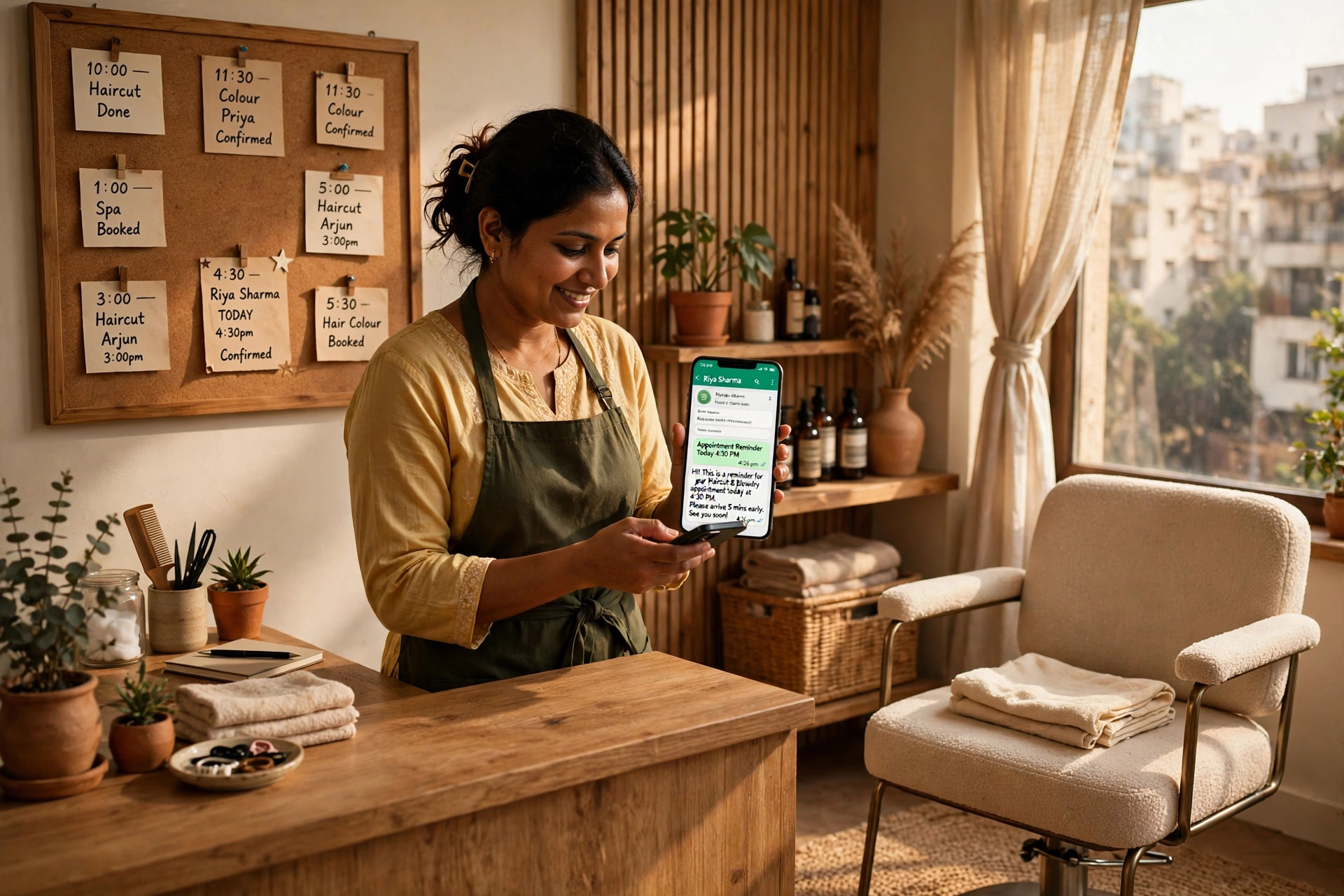
Meet Priya — and her empty chair on a Monday
Priya runs a four-chair salon in Malad West, Mumbai. Haircuts start at ₹400, colour and keratin run ₹2,500–₹6,000, and Saturdays are booked out a week ahead. Mondays are the problem: last Monday two of her nine bookings never showed up and never called. One was a 90-minute colour slot worth ₹3,500. The chair sat empty, the stylist stood idle, and the waitlist client who would have taken that slot found out too late.
That is the whole no-show problem in one morning: the loss is not just the ₹3,500. It is the stylist's idle hour and the client who could not get in. Salon trainer Phil Jackson puts the scale plainly: salons lose 5–10% of monthly revenue to no-shows — on a salon billing ₹3 lakh a month, ₹15,000–₹30,000 gone every month to chairs that were booked and then empty.
This guide is the fix Priya actually needed: a no-show system built for how Mumbai salons really work — WhatsApp, UPI, and clients who book on the phone, not on a card-on-file form.
What a no-show really costs you
The empty chair. A four-chair salon doing 25 bookings a day, six days a week, makes about 600 bookings a month. At a 10% no-show rate — the top of Phil Jackson's range — that is 60 empty slots. At an average bill of ₹800, that is ₹48,000 a month; at half that rate, ₹24,000.
The idle stylist. Your stylist is paid for the hour whether a client sits in the chair or not. Two no-shows a day is roughly 60 stylist-hours a month — a full working week of one stylist, paid for and wasted.
The client you turned away. Every no-show slot was a slot you told someone else was full. That client went to the salon down the road, and some never come back. This is the cost nobody puts in a spreadsheet, and it compounds.
Why clients no-show
They forgot. This is the biggest group by far. A client books on Saturday for Wednesday, life happens, and Wednesday arrives without the appointment ever crossing her mind again. No reminder was sent, or it went to SMS.
They changed their mind. She booked two salons, or the plan changed, and cancelling felt awkward — so she did not come. There was no easy way to cancel.
They never intended to commit. A few bookings are made casually — a friend booked for her, someone was "just checking". A booking that costs nothing to make costs nothing to skip.
If the service is good, no-shows are a systems problem — and systems are fixable in a week.
Step 1: WhatsApp reminders from your own number — 24 hours and 2 hours before
This is the single highest-return change, and it costs almost nothing.
Why WhatsApp, not SMS. Your clients live on WhatsApp. An SMS reminder lands in a pile of bank alerts and OTPs; a WhatsApp message from your salon's own number, with your name and photo, gets seen — and she can reply to it.
The cadence that works: T-24 hours and T-2 hours. One reminder is not enough, and three is annoying:
- 24 hours before: "Hi Riya! Your haircut with Neha is tomorrow at 4:30 PM. Reply YES to confirm, or tap here to reschedule." This catches the client who forgot, and gives her a day to move the booking instead of vanishing.
- 2 hours before: "See you at 4:30 PM today! Running late? Reply here and we will hold your slot for 15 minutes." This catches the client who confirmed yesterday and forgot again today.
The confirm button is the whole trick. Every reminder must ask for a YES. A client who taps YES has made a small promise, and people keep small promises. A client who does not reply to the 24-hour reminder gets a short follow-up call the same evening — your early warning, while the slot can still be refilled.
Keep it human. Use the client's name, the service, the stylist's name, the time, and one clear action — always from your salon's own number.
Step 2: A small UPI advance at booking — ₹200–₹500, only where it earns its place
This is the step owners fear: "If I ask for money upfront, clients will go elsewhere." Owners who have done it say the opposite — provided the advance is small, refundable, and asked for only on the right services.
How much? ₹200–₹500, adjusted to the service. A ₹400 haircut needs no advance; a ₹3,500 colour, a ₹5,000 keratin, a 2-hour bridal trial get ₹500. Ask only where the slot is long or the service is expensive — that is where a no-show hurts.
Why UPI, not a card. International salon software uses card-on-file: the client saves a card, and the salon charges a no-show fee. That breaks in India. Fresha owners report clients can enter an invalid card and still book, so the fee can never be charged; Booksy owners report the same when the card is expired. In India the equivalent is UPI: the client pays ₹500 at booking, in ten seconds, from the app she already uses. No card form, no expired-card failure.
How to say it so clients accept it. Never call it a "no-show fee" at booking time. Say: "We take a small ₹500 advance to reserve your 2-hour colour slot — it is adjusted in your final bill, and fully refunded if you cancel more than 24 hours ahead." That explains the reason, removes the risk, and sets the rule before the client ever needs to hear it.
The refund rule — never break it. If a client cancels more than 24 hours ahead, refund the advance the same day, on UPI. Keep it only when she cancels inside 24 hours or does not show up — and tell her that at booking time, not after the fact.
Step 3: A cancellation policy clients actually accept
A policy only works if clients know it before they need it, and if it feels fair. Put it on your booking page, your WhatsApp booking message, and a card at reception:
- Cancel more than 24 hours ahead: full refund of the advance, reschedule free.
- Cancel inside 24 hours: the advance is kept as a late-cancellation fee — told to the client at booking time.
- No-show with no message: the advance is kept, and the client's next booking needs an advance even for a short service.
- Running late: the slot is held for 15 minutes, then offered to the waitlist.
Why this policy gets accepted: it is symmetrical — the salon gives a guaranteed slot, a reminder, and a refund when the client is fair. Say it at booking, say it in the reminder, and enforce it the same way for every client, including regulars.
Step 4: A waitlist that refills a cancelled slot in minutes
Even the best system still gets cancellations. The difference between a lost slot and a recovered slot is a waitlist that works automatically.
How it works in practice. When a client cancels — by tapping the link in the reminder, or replying to your WhatsApp — the system messages the first person on the waitlist: "A 4:30 PM haircut slot with Neha just opened today. Reply YES in 10 minutes to take it." No reply, and it goes to the next person. No phone calls, no paper diary.
Why most salons do not have this: their booking tool has no waitlist at all, or the waitlist is a notebook nobody checks. When you compare booking software, ask: "When a client cancels, does the waitlist get messaged automatically?" If the answer is a manual feature, the answer is no.
The honest comparison: what salon booking software actually costs in India
A booking tool is only worth it if it does all four steps above. Here is how the real options compare for a small salon in India, using prices from the vendors' own pages and review sites in November 2026. International prices are marked as international.
| Tool | What you pay | WhatsApp reminders | UPI advance / deposit | The catch, from real reviews |
|---|---|---|---|---|
| Fresha | Free to start; 20% fee on new clients booked through the Fresha marketplace (minimum £4) | Yes, but on paid tiers | Card-based no-show fee | The 20% fee hits even your own clients; owners report invalid cards defeat the no-show fee, and payouts are slow |
| Booksy | $29.99/month (international) plus $20 per extra user; 30% Boost commission | Yes | Card-based cancellation fee | The 30% Boost fee hits your own clients too; owners report the fee fails on expired cards and support is unresponsive for weeks |
| Zenoti | From $300/month (international) | Yes | Yes, card-based | Priced for chains, not a four-chair salon; owners report four-month onboarding and double bookings |
| MioSalon | Around ₹2,083/month (Standard, India) | Yes, with reported delays | Yes | India-built; owners report it is hard to learn, has no mobile app, and WhatsApp integration is delayed |
| Calendly | $10 per seat per month (international) | No — reminders are paywalled | No | Built for meetings, not salons; per-seat pricing adds up with every stylist, and owners report flaky timezones |
| VisionQuantech Appointment Booker | ₹6,999 one-time setup + ₹799/month flat for the whole team | Yes — from your own number, included | Yes — UPI advance at booking, included | Setup done for you on request; not a self-serve signup |
The global tools are either free until they are not — Fresha's 20% and Booksy's 30% are charged on clients you already had — or priced for chains: Zenoti starts at $300 a month, roughly ₹26,000. The Indian tools are closer, but MioSalon's owners report the WhatsApp integration — the most important feature in this guide — is the part that is delayed.
The comparison that matters is not the monthly price. It is the cost of one empty chair a day: at Priya's average bill of ₹800, one no-show a day is about ₹19,200 a month — more than any tool on this table.
The 7-day setup test — do this before you pay anyone
Do not buy software on a sales call. Run this test in your own salon for one week. Day 1 — Measure: count last week's no-shows and write the number on the reception board. Day 2 — Write the policy: copy the Step 3 policy onto your booking message, WhatsApp profile, and a card at reception. Day 3 — Turn on WhatsApp reminders: the two reminders, 24 hours and 2 hours before, from your own number, with a YES confirm and a reschedule link. Test it on your own phone first. Day 4 — Start the UPI advance: ₹200–₹500 only on services over ₹2,000 or longer than 90 minutes. Day 5 — Open the waitlist: tell every client who cannot get her slot that you will message her the moment one opens. Day 6 — Call the non-repliers: every client who ignored the 24-hour reminder gets a short call the same evening. Day 7 — Count again. If the number fell, the system works — usually visibly in one week. Keep counting every Monday. What gets counted gets fixed.
What not to do
Do not charge a full no-show fee on a first offence. A client who forgot once and gets charged the full ₹3,500 becomes a former client — and tells her friends why. The advance is the fee: small, known in advance, refundable on timely cancellation.
Do not rely on SMS reminders. They are cheap, and they are ignored. If your booking tool only sends SMS, it is not solving the problem in India.
Do not ask for an advance on every service. A ₹200 advance on a ₹300 cleanup is the fastest way to lose walk-in clients. Advances belong on long and high-value services only.
Do not keep the policy a secret. A rule the client learns after the fact is not a policy — it is a surprise bill. Say it at booking, repeat it in the reminder.
Do not buy the chain-priced tool for a four-chair salon. Zenoti is a serious product for a serious chain. A small salon paying $300 a month for it is paying for features it will never open.
Frequently asked questions
How do I stop salon no-shows without losing clients?
Use three things together: WhatsApp reminders from your own number 24 hours and 2 hours before the appointment, a small UPI advance of ₹200–₹500 on long services only, and a waitlist that refills cancelled slots automatically. The advance must be refundable on timely cancellation.
Do WhatsApp reminders really work better than SMS for salons?
Yes, because your clients actually open WhatsApp. An SMS reminder lands among bank alerts and OTPs; a WhatsApp message from your salon's own number gets seen and replied to with one tap. It also needs a YES confirm and a reschedule link.
How much advance should I ask for a salon booking in India?
₹200–₹500, only for services over about ₹2,000 or longer than 90 minutes — colour, keratin, bridal trials. Never on a ₹300–₹400 haircut or cleanup. Take it by UPI at booking, adjust it in the final bill, and refund it in full if the client cancels more than 24 hours ahead.
Is Fresha really free for salons in India?
Fresha is free to start, but it charges a 20% fee on new clients booked through its marketplace — and owners report the fee hits their own clients too, including on tips and tax. Owners also report clients can book with an invalid card, so Fresha's card-based no-show fee cannot be charged.
Can I charge a no-show fee if the client never gave a card?
Not reliably — which is exactly why the UPI advance matters. Card-based fees fail when the card on file is expired or invalid, a complaint in reviews of both Fresha and Booksy. A UPI advance taken at booking is already in your account, so there is nothing to chase. Explain the fee at booking time and refund it on timely cancellation.
How do I fill a cancelled salon slot at the last minute?
Keep a waitlist in your booking tool and let the tool message it automatically the moment a cancellation comes in: the first person gets ten minutes to reply YES, then it goes to the next person. A paper waitlist nobody checks does not work.
References
- Fresha — pricing and marketplace fees — https://www.fresha.com/
- Booksy — pricing for salons — https://booksy.com/
- Zenoti — salon software pricing — https://www.zenoti.com/
- MioSalon — salon software for India — https://www.miosalon.com/
- Calendly — pricing per seat — https://calendly.com/pricing
- Zoho Bookings — appointment scheduling — https://www.zoho.com/bookings/
- GlossGenius — reducing salon no-shows — https://glossgenius.com/
- Build Your Salon (Phil Jackson) — salon no-show rates and deposit policies — https://buildyoursalon.com/
- Capterra — Fresha reviews and rating — https://www.capterra.com/
- Trustpilot — Booksy reviews and rating — https://www.trustpilot.com/
- VisionQuantech AI assistant for salons — https://visionquantech.com/blog/ai-assistant-for-salons.html
- VisionQuantech chatbot for salons and spas — https://visionquantech.com/blog/ai-chatbot-for-salon-and-spa.html
Cite this article: Shivam Kumar (2026). How Do I Stop Salon No-Shows in Mumbai With WhatsApp Reminders and a UPI Advance — Without Losing Clients? VisionQuantech. https://visionquantech.com/blog/how-to-stop-salon-no-shows-malad-west-mumbai.html
Talk to us about Appointment Booker for your salon
VisionQuantech Appointment Booker: ₹6,999 one-time setup + ₹799 a month flat for the whole team. WhatsApp reminders from your own number, UPI advance at booking, a cancellation policy that enforces itself, and a waitlist that refills cancelled slots — set up for you on request.
See VisionQuantech AI Services Book a setup call