TL;DR: For a small Chicago real estate agency, an AI SDR costs roughly $250 to $5,000 a month — AiSDR starts at $250, Salesforge's Agent Frank is $499, A fully loaded human SDR costs $120,000 to $200,000 a year. The honest comparison is cost per booked meeting: in a 100,000-email study the AI booked 0.7% of contacts into meetings against a human's 1.1% — at about one-fifth the cost.
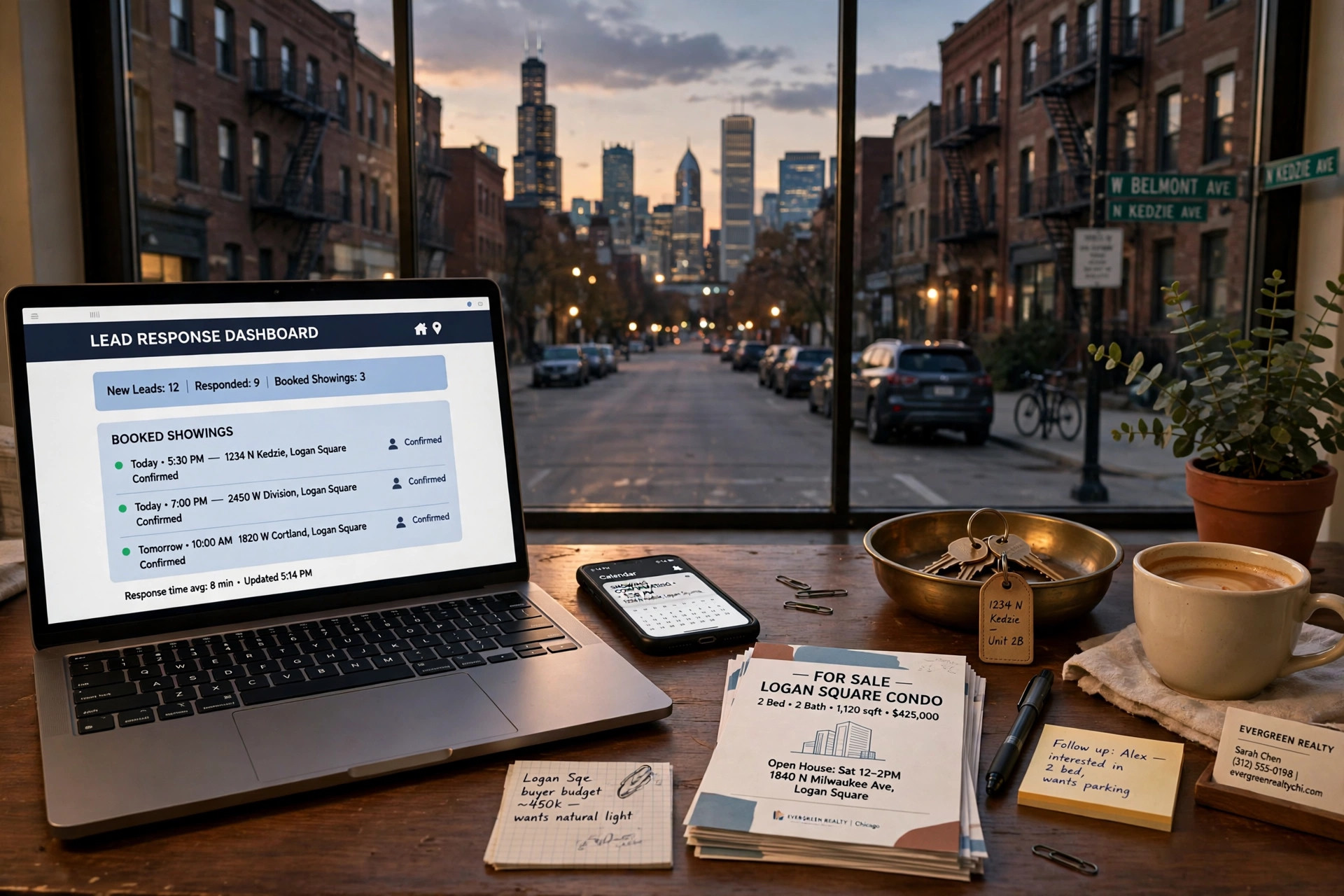
Meet Daniel — and his four-agent brokerage in Logan Square
Daniel runs a four-agent boutique brokerage off Milwaukee Avenue in Logan Square, Chicago. His agents work Wicker Park, Bucktown and Pilsen listings, mostly $450,000 to $900,000 condos and two-flats. His leads come from Zillow, Realtor.com and his own website — about 120 new leads a month —
Every evening the same scene: a showing request lands at 7:40 p.m. while his agents are at a closing dinner, a first-time buyer messages at 9 p.m. asking whether the Logan Square two-flat is still available, and a seller who filled in a valuation form on Sunday morning gets no reply until Monday afternoon. Daniel's agents are good at closing. They are not good at answering within sixty seconds, twelve hours a day — and nobody is, at a four-person brokerage.
The three pricing models — the model matters as much as the number
AI SDR pricing comes in three shapes. Pick the model first, then the vendor.
Per-seat or per-user. You pay for each person who uses the tool, like ordinary software. Regie.ai reportedly runs $180 to $499 per user per month. For a four-agent brokerage this is the most expensive shape, because you pay four times for one job.
Flat monthly tiers. One fixed price for a bundle of capacity. AiSDR publishes $250, $900 and $2,500 a month tiers. Salesforge's Agent Frank is $499 a month. Reply.io's Jason AI runs roughly $500 to $800 a month on top of its sequencing platform. The price is predictable — but you can pay for capacity you never use, or hit a ceiling that forces a jump to the next tier mid-month.
Usage-based. You pay for the work performed, not for seats. Artisan charges in usage-based credits with no platform fee, so the cost tracks the actual emails sent and replies handled. HubSpot's Breeze introduced outcome-based pricing of around $1.00 per qualified lead in April 2026.
What a Chicago human SDR actually costs
Before you compare any AI price, price the human properly — because almost every vendor comparison cheats by comparing the AI's monthly fee against a human's base salary. The base salary is the small part.
A US SDR's base salary starts around $60,000. Fully loaded — commission, benefits, payroll taxes, the outbound software stack, management overhead and onboarding — a single SDR costs $120,000 to $200,000 a year (Artisan, 2026). Ramp is three to six months, average tenure about 14 months — so a rep may deliver only eight to eleven months of full output before you pay to replace them. Then there is the busywork tax: SDRs spend 40 to 60% of their hours on non-selling tasks. Daniel's version is simpler: one Chicago SDR hire would cost him roughly $10,000 to $16,700 a month fully loaded — more than his office rent — and that hire still sleeps, takes weekends off, and quits after about 14 months. The question is not whether the AI is cheaper than a human. It is whether the AI is cheaper per booked showing.
The priced comparison: what Daniel's four-agent Logan Square agency actually pays
Prices below are published or best-reported figures as of November 2026, excluding taxes.
| Platform | Sticker price | What a small agency actually pays | Best for |
|---|---|---|---|
| AiSDR | $250 / $900 / $2,500 per month | $250/mo entry; $900/mo once volume grows | Cheapest honest entry point; pay-as-you-scale tiers |
| Salesforge (Agent Frank) | $499 per month | $499/mo, billed quarterly | Small teams wanting one flat price |
| Reply.io (Jason AI) | ~$500–$800 per month | ~$500–$800/mo on top of the sequencing platform | Teams already using Reply.io |
| Regie.ai | $180–$499 per user per month | $720–$1,996/mo for four users | Teams that want per-seat control |
| 11x (Alice) | ~$5,000 per month (reported) | ~$5,000/mo, quote-only, long onboarding | Enterprise teams, not small agencies |
| Artisan (Ava) | Usage-based credits, no platform fee | Scales with work done; reported ~$1,500–$3,000/mo single-seat | Volume-led teams that hate seat pricing |
| Apollo.io | $49 per user per month (Basic) | ~$196/mo for four users, plus AI add-ons | Prospecting + data in one tool |
| VisionQuantech AI SDR | $2,500–$4,500 one-time setup + $500–$800/mo care (Starter) | $2,500–$4,500 setup, then $500–$800/mo; Growth $4,500–$6,500 setup + $999/mo; All-in-One $8,500–$12,500 setup + $1,999/mo | Agencies that want it installed for them, not another tool to learn |
Read the table the way Daniel should: the cheapest sticker is not the cheapest system. Apollo.io at $49 a user looks cheapest, but it is a prospecting database with AI features bolted on — somebody still has to run the campaigns. AiSDR at $250 a month is the cheapest true AI SDR, but a 120-lead-a-month agency will outgrow the entry tier by spring. The VisionQuantech row is different in kind: it is an installed-for-you service, not a self-serve tool. The setup fee buys the build — sources connected, script written, calendar wired — and the monthly care is the running cost. A founding-client offer of 20% off the first project setup applies to the first 10 clients only.
The hidden stack nobody quotes
Here is where most AI SDR budgets break. The sticker price is the tool. The system needs four more things, and vendors rarely put them on the pricing page.
Mailboxes and domains. Cold email at volume needs separate sending domains and warmed-up mailboxes, or your main brokerage domain gets flagged. Budget $50 to $150 a month for two or three domains and mailboxes, plus two to four weeks of warm-up before the first real campaign.
Data. The AI can only email people it knows about. A list of Chicago homeowners thinking of selling, or buyers who enquired six months ago, costs money — either a data subscription or the hours to build the list from your own CRM. Start with the list you already own: past enquiries, old valuation requests, open-house sign-in sheets.
The qualification script. An AI SDR is only as good as the questions it asks. "Are you pre-approved, and what is your timeline?" is a qualification. "Hi, just checking in!" is spam. Writing the script — what counts as a hot lead, what counts as a polite no, when to hand over to a human — is a day of real work.
Human review. The honest vendors say this plainly: an AI SDR works when a person checks what goes out. Budget one hour a day for the first month: an agent scanning the replies and fixing the bad ones. Add the stack to the sticker and Daniel's real first-year cost for a $499-a-month tool is roughly $7,500 to $9,000, not $5,988. Still about one-fifteenth of a human hire — but quote the honest number, not the sticker.
The honest maths: cost per booked meeting
This is the number that decides the purchase, and it comes from the best head-to-head test published this year. In April 2026, Digital Applied ran 100,000 paired cold emails — the same lists, the same offers, AI against human. The results: reply rate AI 4.1% against human 5.2%; positive replies 1.4% against 2.1%; meetings booked 0.7% against 1.1%; inbox placement 71% against 86%; spam-flag rate 8% against 3%.
Read that honestly. The human wins every rate. The AI books roughly two-thirds as many meetings per thousand emails. But the AI costs roughly one-fifth as much — Artisan's own framing is that teams generate pipeline at about one-fifth the cost of a human rep. That is the whole case, and it only holds if you measure cost per meeting, not meetings per thousand emails.
Daniel's version: at 120 fresh leads a month plus a 2,000-person old-enquiry list, a human SDR working his list might book 22 meetings a month at about $10,000 loaded — roughly $450 per meeting. An AI SDR at $499 a month plus the hidden stack, booking two-thirds as many, lands near $45 to $60 per meeting. Even if the AI's meetings are slightly colder, the maths is not close.
Two honest cautions. First, the AI's lower inbox placement (71% against 86%) is a deliverability problem you must manage — warm domains, clean lists, a human checking the spam folder. Second, meeting quality: one practitioner case study from Mumbai real estate claims 1,700 AI calls produced 550 booked meetings (32%), with the AI reaching 100% of leads within 60 seconds against manual SDRs reaching about 15% within an hour — but that is the vendor's own case study, not independent data. Treat it as a claim to test. The speed claim underneath it is worth taking seriously: the same practitioner reports that a reply within one minute converts at 98%, falling to 30% after one hour. Daniel's Sunday-morning valuation enquiries currently wait until Monday afternoon. Whatever tool he buys, the first thing it must fix is that wait.
What the reviews actually say
The review pages are where the per-meeting maths meets reality. Artisan, the best-known AI SDR, scores 3.9 out of 5 from 22 reviews on G2 — a polarized spread, with 72% five-star reviews and 13% one-star reviews. On Trustpilot it holds 4.6 out of 5 from 28 reviews. The five-star reviewers praise hands-off pipeline; the one-star reviewers report zero replies after 1,400 emails sent, generic "AI slop" copy, poor lead sourcing, buggy warm-up and DNS setup, and no Salesforce integration.
The harshest line in the reviews is the one Daniel should remember: unsupervised bots "generate low quality meetings and burn through addressable market lists." The pattern is consistent: the tool works when the agency treats it as a junior rep that needs a narrow list, a real reason to email, and a human checking the output.
The staged system: no SDR to AI SDR in four steps
A four-agent brokerage does not need to buy an AI SDR on day one. The cheapest path is staged, each stage with a clear break-point.
Step 1: Answer the phone faster with what you already own (this week, $0). Daniel's fastest win costs nothing: a shared rota so one agent owns the inbox after 6 p.m., and a WhatsApp auto-reply that says when a human will call back.
Step 2: A flat-tier AI SDR on your own old list (one month, ~$250–$499). Take the 2,000 old enquiries, clean them, and run one campaign with a narrow offer — a valuation, a new-listing alert, a showing invitation. Watch three numbers: inbox placement, reply rate, meetings booked.
Step 3: Add the hidden stack properly (month two, ~$100–$150 a month). Separate sending domains, warmed mailboxes, the qualification script rewritten from what month one taught you, and one hour a day of human review. This is the step that separates the 0.7% meeting rate from the zero-reply review.
Step 4: An installed-for-you system (when the volume justifies it). When the list is working and the agents are spending their days on showings instead of chasing replies, the setup fee starts to make sense: somebody builds the whole system — sources, script, calendar, WhatsApp follow-up — and the agency pays the monthly care instead of learning another tool.
The seven-day test — run it before you buy anything
Do not switch on a demo. Run this test for one week, and let the numbers decide.
Day 1: Count your real volume. How many leads arrived last month, from which channels, and how many got a first reply within an hour?
Day 2: Time the first answer. Take ten enquiries from yesterday and check when each got its first real reply.
Day 3: Price the same month three ways. The sticker ($499 a month), the loaded cost (tool plus domains, data and review time), and one human SDR hire at $10,000-plus a month loaded.
Day 4: Check the export button. Ask each vendor to show a one-click export of your full prospect list and reply history, live, without a support ticket. If they cannot, you are renting your own leads.
Day 5: Read ten real replies. Ask the vendor for ten anonymised reply threads from a real-estate client. If the copy reads like generic AI slop, your Chicago sellers will read it the same way.
Day 6: Call support on a Saturday night.
Day 7: Decide on the maths, not the demo. If the cost per booked meeting beats your human hire by 5x or more and the reply quality passes the ten-thread test, buy the flat tier. If not, fix the after-hours rota first — it costs nothing.
The verdict, by agency size
One or two agents, under 60 leads a month: fix the after-hours rota and the WhatsApp auto-reply first. An AI SDR is a second hire for a problem you have not measured yet.
Three to five agents, 100–200 leads a month (Daniel today): a flat-tier AI SDR at $250–$499 a month, on your own cleaned list, with the hidden stack budgeted honestly. Expect roughly two-thirds of a human's meeting rate at roughly one-fifth of the cost —
Six-plus agents, or a team running paid ads at volume: a usage-based tool like Artisan, or an installed-for-you system where the setup fee buys the build.
An agency that lives on speed and showings: whichever system you pick, the first reply inside a minute and the calendar booking must be included in the price, not sold as add-ons — see how an AI receptionist for real estate and a real estate CRM handle the first reply before an agent does, and how an AI phone answering service for real estate agents covers the after-hours calls.
Daniel picked the installed-for-you AI SDR: his leads come from three portals, his agents close and do not chase, and his next hundred leads should not need another hire.
Frequently asked questions
How much does an AI SDR cost for a small real estate agency?
Roughly $250 to $5,000 a month depending on the model. AiSDR starts at $250 a month, Salesforge's Agent Frank is $499, Reply.io's Jason AI runs about $500–$800, and 11x is reported near $5,000. An installed-for-you AI SDR from VisionQuantech starts at $2,500–$4,500 one-time setup with $500–$800 a month care.
How much does an AI SDR cost compared to a human SDR?
About one-fifth the cost per pipeline generated, on Artisan's comparison. But the AI books fewer meetings per thousand emails: 0.7% against a human's 1.1% in a 100,000-email study. Per dollar spent, the AI still books more meetings.
Is an AI SDR worth it for a small agency in Chicago?
Yes, if the agency has 100-plus leads a month and a slow first reply. The win is speed: the first reply inside a minute converts far better than one after an hour. Under 60 leads a month, fix the after-hours rota first — free.
Can an AI SDR book property showings automatically?
Yes — that is its core job: qualify the lead, check the agent's calendar, and book the showing. The honest limit is complex questions: language models still hallucinate facts, so the handover to a human must trigger on anything the script does not cover.
What are the hidden costs of an AI SDR?
Separate sending domains and warmed mailboxes ($50–$150 a month), the data list, the qualification script, and about an hour a day of human review in the first month. A $499-a-month tool costs roughly $7,500 to $9,000 in its first year all-in
Do AI SDRs actually work?
They do when the list is narrow, the offer already sells, each message has a real reason, the data is good, and a person checks what goes out. They fail as unsupervised bots on bought lists — reviewers report zero replies after 1,400 emails and burned addressable markets.
References & further reading
- Artisan — How much does an AI SDR cost? AI vs human pricing 2026 (AI SDRs $500–$5,000/mo; human SDR $120,000–$200,000/yr loaded; 3–6 month ramp; ~14 month tenure; 40–60% busywork; one-fifth pipeline cost) https://www.artisan.co/blog/how-much-does-an-ai-sdr-cost-pricing-compared-to-human-sdrs
- Digital Patron — Best AI SDR agents 2026 (published prices checked 5 Nov 2026: AiSDR $250/$900/$2,500; 11x $3,750/mo annual; Salesforge Agent Frank $499/mo) https://digitalpatron.in/blog/best-ai-sdr-agents-2026
- Plura — AI SDR response rate: Digital Applied 100,000 paired cold emails, Apr 2026 (AI 4.1% reply, 0.7% meetings, 71% inbox, 8% spam-flag vs human 5.2%, 1.1%, 86%, 3%) https://www.plura.ai/articles/ai-sdr-response-rate
- Sista — AI SDR vs human SDR results 2026 (same Digital Applied study, second source) https://sista.ai/en/insights/ai-sdr-vs-human-sdr-results-2026
- Prospeo — Artisan reviews synthesis (G2 3.9/5 from 22 reviews; recurring complaints: zero replies after 1,400 emails, generic copy, no Salesforce integration) https://prospeo.io/s/artisan-reviews
- ColdReach — Artisan AI review (G2/Trustpilot scores and complaint patterns) https://coldreach.ai/blog/artisan-ai-review
- Drippl — AI answering for real estate (vendor claim: 62% of after-hours calls unanswered; 78% of chat messages left hanging) https://drippl.com/
- Siela — Do AI SDRs work? (works when ICP is narrow, offer sells, message has a real reason, data is good, a person checks output) https://www.siela.us/blog-do-ai-sdrs-work
- VisionQuantech — AI SDR service page (Starter $2,500–$4,500 setup + $500–$800/mo care; Growth $4,500–$6,500 + $999/mo; All-in-One $8,500–$12,500 + $1,999/mo; founding-client 20% off setup, first 10 clients) https://visionquantech.com/employee-ai-sdr.html
Cite this article: Shivam Kumar (2026). How Much Does an AI SDR Cost for a Small Real Estate Agency in Chicago?. VisionQuantech. https://visionquantech.com/blog/how-much-ai-sdr-cost-small-real-estate-agency-chicago.html