TL;DR: Yes — a small restaurant in India can run well without expensive software, but not without a system. Start free: cost every dish so food cost stays in the 28–35% band, log waste daily (Indian restaurants throw away 15–20% of what they buy), and close each day with one number — cash in hand versus cash expected. When the sheets break — 50+ bills a day, two cash handlers, lost orders — move to one flat-price system.
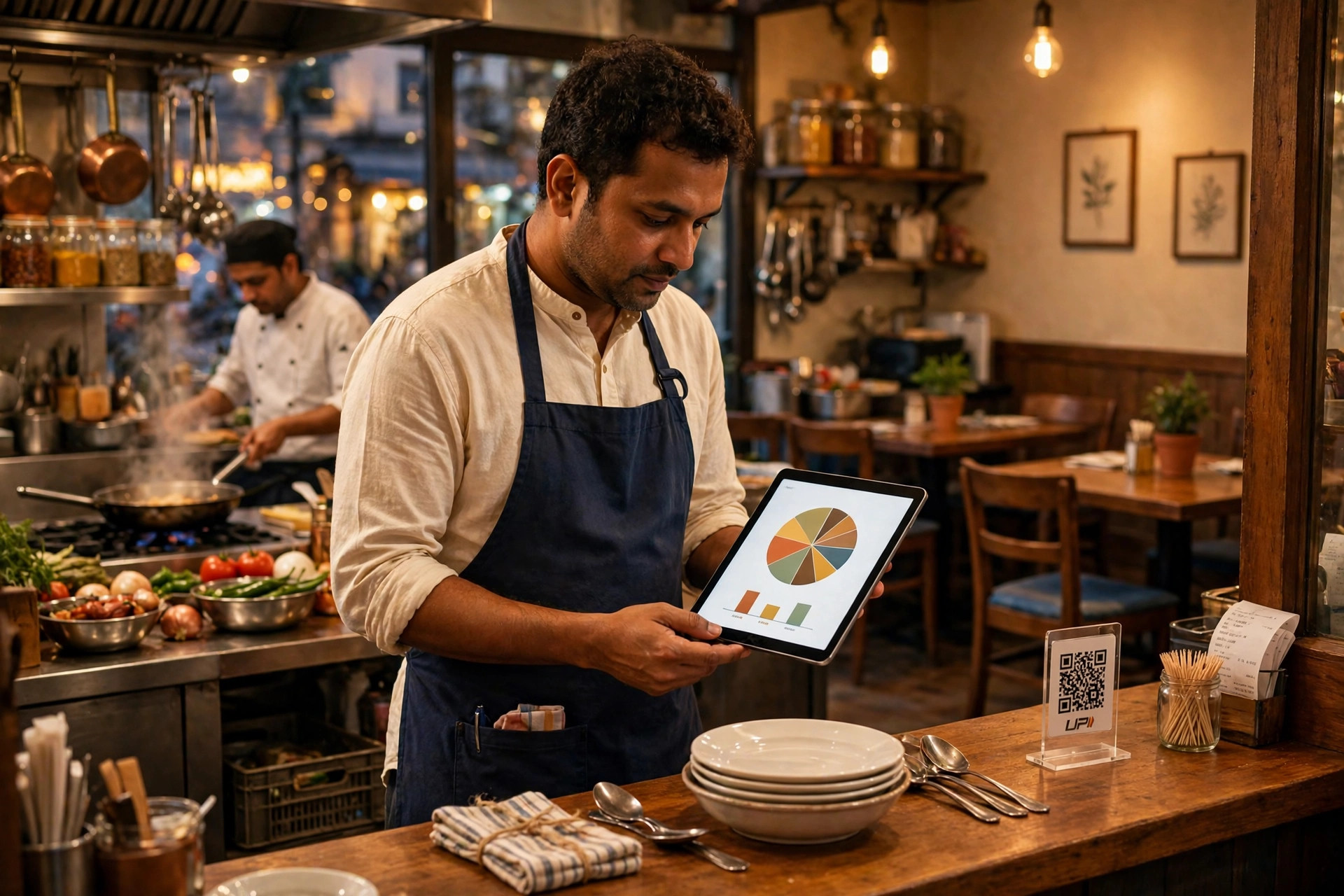
Meet Raj — and his Friday-night billing counter in Goregaon West
Raj runs a 24-seat vegetarian restaurant off SV Road in Goregaon West, Mumbai — thalis at ₹220, paneer dishes at ₹280. Last Friday his counter did ₹31,000 in sales. On Saturday morning he counted the cash, checked the Swiggy and Zomato payouts, and could not answer the only question that matters: did Friday actually make money?
He knew the total sales. He did not know his food cost, how much was wasted, how many delivery orders never reached the kitchen, or whether the ₹31,000 covered the day's expenses. Busy but not profitable — that gap is the real problem of the small Indian restaurant.
India's food services market was valued at ₹5.69 lakh crore in 2024 and is projected to reach ₹7.76 lakh crore by 2028, growing at 8.1% a year (NRAI). The market is growing. Whether your restaurant keeps any of it is decided at the billing counter.
This guide is the system Raj needed: what to run on free tools, what to watch daily, and the exact point where free stops working.
What "managing a restaurant" actually means — five jobs, not one
Owners say "manage my restaurant" and mean five jobs at once — each with a different cheap fix.
Job 1: Billing and the kitchen. Taking the order, printing the KOT (kitchen order ticket), billing correctly, collecting payment — cash, UPI, or card. When this breaks, tables wait and money leaks.
Job 2: Food cost. Knowing what each dish costs to make, and whether the menu price leaves enough margin. Food cost is 30–40% of revenue for Indian restaurants, so a three-point slip wipes out the month's profit.
Job 3: Stock and waste. Buying the right quantities, using older stock first, knowing what gets thrown away. Indian restaurants waste an estimated 15–20% of what they buy (NRAI data).
Job 4: Delivery channels. Swiggy and Zomato orders alongside dine-in, at 22–25% commission plus discounts the restaurant funds. A ₹400 order can be ₹300 after commission and discount — and the kitchen still cooked the full dish.
Job 5: Staff and the day-close. Who worked, who handled cash, and one honest number at day-end: cash in hand versus cash expected. Without a day-close, small shortages stay invisible until they are large.
A big enterprise system does all five at once — and charges enterprise money for it. A small restaurant needs each job covered by the cheapest method that works, and an upgrade path when that method breaks.
Step 1: Cost every dish on a free sheet — tonight
This is the highest-return hour in the whole guide, and it costs nothing:
What food cost percentage means. Money spent on raw materials divided by money earned from food sales, times 100. Spend ₹32,000 to sell ₹1,00,000 of food and your food cost is 32%. The healthy range is 28–35%; the operators who stay profitable sit closer to 28–32%.
How to do it in one evening. List your top 20 dishes — usually 80% of sales. For each, write the recipe in grams, ingredient prices, and the plate cost. A paneer butter masala costing ₹96 and selling at ₹280 runs at 34%. At ₹240 it runs at 40% — losing money on every order.
The one test that matters. Add up the plate costs of everything sold yesterday and divide by yesterday's food sales. Above 35% means a pricing or portion problem — more sales at a loss just lose money faster.
A real number from Raj's counter. Raj bills about ₹8 lakh a month. At 38% food cost he spends ₹3,04,000 a month on raw materials; at 32%, ₹2,56,000. The difference — ₹48,000 a month, ₹5,76,000 a year — is the business's entire profit, decided by recipe cards and a weighing scale.
Step 2: Track waste every day — the bin is where profit goes
Waste is the cost nobody sees because it leaves through the back door. A daily waste log — a notebook by the bin — beats any dashboard at this size.
What to log. One line per item thrown away each day: what, how much, and why — overproduction, spoilage, prep trim, or a returned dish. Two minutes at closing time. Buy ₹3,04,000 of raw material a month and waste 15%, and you throw away ₹45,600 a month — a cook's salary, in the bin.
The three fixes that cost nothing. Cook to a prep sheet — morning portions from yesterday's sales, not optimism. Use older stock first. Track the top three wasted items and cut their order quantity by a quarter next week.
Why software matters here eventually. A sheet tells you what was wasted. It cannot flag paneer usage jumping 20% while paneer sales stay flat — pilferage or portion drift, the pattern a recipe-level system catches.
Step 3: Close every day with one number
The day-close is a five-minute ritual — the cheapest fraud and cash control a small restaurant has.
The ritual. At closing: count the drawer cash, add UPI and card settlements and the Swiggy/Zomato payouts. That is cash in hand. Compare it with the day's total bills — they should match. If not, you find out tonight, not at month-end.
Why it matters more than any report. A restaurant doing ₹8 lakh a month that leaks 2% at the counter loses ₹16,000 a month — ₹1,92,000 a year. The leak is never one big theft; it is unbilled items, a KOT that never became a bill, a discount applied without approval.
Free tools for the job. A Google Sheet with one row per day — date, dine-in sales, delivery sales, cash, UPI, card, payouts, expenses, and the difference — is enough for one outlet. The Petpooja blog's free P&L template uses the same structure.
Step 4: Do the delivery maths before you celebrate delivery sales
Delivery is the fastest-growing slice of the Indian market — cloud kitchens grow at roughly 18% a year — and the slice where margins hide.
The real payout on a ₹400 order. At a 23% commission and a 10% discount you fund, the platform keeps about ₹132 and you receive about ₹268 before food cost. If that dish costs ₹110 to make, you keep ₹158; at the table you keep ₹290. Pricing delivery like dine-in is how sales grow and profit shrinks.
Three rules that cost nothing. Keep a separate delivery menu price where allowed. Reconcile every payout weekly: the partner app shows what was ordered, the bank shows what arrived, and the gap is commission plus discount plus tax. Track delivery as its own day-close line.
Should I build my own ordering website instead? Your own channel saves the commission but costs you the platform's demand. Keep the platforms, price for them, and add QR ordering at the table first.
Step 5: Staff, roster, and the two-person rule
A small restaurant has three to eight staff, and the owner is usually also the manager, the cashier, and the complaints desk. The system has to survive the owner being away for a day.
Write the day down. One page: who opens, who handles the cash, who closes, and what happens when the owner is not there. A restaurant that only works when the owner is at the counter is not a system — it breaks on the first sick day.
The two-person rule for cash. Nobody who takes an order should close the day's cash alone. In a three-person team, the cook's KOT count and the counter's bill count get compared at closing — the Step 3 day-close, done by two people. It costs nothing.
Attendance without a machine. A WhatsApp photo of the attendance register each morning is enough at this size. Biometric machines earn their place past about 15 people or two outlets.
Step 6: The break-point test — when free tools stop working
Free sheets work until they do not. If any two of these are true, the sheets cost more than a system would:
- More than about 50 bills a day. Manual billing slows the counter, and the KOT-to-bill gap starts leaking orders.
- Two or more people handling money. Reconciling two cash handlers by hand every night is an hour you do not have.
- Delivery orders getting lost. Swiggy and Zomato orders reaching the kitchen late, twice, or not at all — the counter juggling three screens.
- You do not know this week's food cost. If the answer takes an evening of arithmetic, you are managing by memory.
- Menu changes take days. A price change that needs a support call and a technician visit is a system charging you for its own slowness.
When two are true, the question becomes "which software costs the least for what I need" — and that has a priced answer.
The priced answer: what the options actually cost
| Option | What you pay | What it does well | Where it falls short |
|---|---|---|---|
| Google Sheets + notebook | ₹0 | Recipe costing, waste log, day-close | Breaks past ~50 bills/day |
| Free tools (BYNOQ, Rasoi Hisaab sheets) | ₹0–₹299 one-time | Food-cost, recipe, GST and break-even calculators | Calculators, not a running system |
| DotPe | ₹1,499+/mo | UPI-native QR ordering, instant settlement | Ordering only; not a full manager |
| ScanDine | ₹999–₹1,999/mo | QR ordering, KDS, queue management | Dine-in focused; no ground support |
| Petpooja | ₹10,000/outlet first year; ₹5,000–₹12,000/mo with add-ons | Deepest integrations (80+), ground support in 30 cities | G2: inventory sync issues + slow performance (14 mentions each); quote-only pricing |
| LimeTray | ₹4,999+/mo indicative | Own website/app ordering, loyalty, marketing | Chat-only support, weak analytics |
| Restroworks (POSist) | ₹8,000+/mo + setup, quote-based | Enterprise multi-outlet, central kitchen, franchise reporting | Built for chains; overkill for one outlet |
| VisionQuantech Restaurant Manager | ₹12,999 setup + ₹1,999/mo flat | Offline-first billing, QR ordering with UPI, KDS, Swiggy/Zomato in one dashboard, recipe-level food-cost tracking | Setup-on-request; single-outlet focus |
Petpooja wins on integration depth and ground support — G2 4.7 out of 5 across 289 reviews. But its own reviewers keep reporting the same two problems: inventory that does not sync and a system that slows down during the rush. And nobody publishes its price: the ₹5,000–₹12,000 a month figure comes from a 2026 guide tracking what owners actually pay after add-ons. LimeTray is cheaper on paper and stronger on direct ordering, but its support is chat-only and its analytics are thin.
The VisionQuantech option is priced on the website, not in a quote call: ₹1,999 a month, flat, with menu digitisation, printer and KDS setup done for the owner. It is not the cheapest row. It is the row where the price is the price, billing works offline during the dinner rush, and food-cost tracking is recipe-level.
The 7-day test — run it before you buy anything
Do not buy software on a demo. Run this test for one week, on sheets, and let the numbers decide:
Day 1: Cost your top 20 dishes. Flag anything above 35% food cost. Day 2: Start the waste log by the bin — one line per item, every day. Day 3: Start the day-close: cash in hand versus cash expected, every night. Day 4: Reconcile one week's Swiggy and Zomato payouts against the bank. Day 5: Fix the worst plate-cost offender — re-price it, re-portion it, or drop it. Cornell research shows removing the currency symbol from a menu lifts guest spend by about 8.1%, and sensory descriptions lift willingness to pay by up to 27%. Day 6: Run the break-point test from Step 6. Day 7: Add up the week — food cost percentage, waste in rupees, day-close gaps, delivery's real margin. If the leak beats ₹1,999 a month, a flat ₹1,999 a month system is the cheapest way to stop it.
Raj ran the test. His food cost was 38%, his waste ran near ₹40,000 a month, and his Friday day-close was short by ₹1,800 twice. The sheets found the leaks. A system stops them coming back.
Frequently asked questions
Can I really manage a small restaurant without any software?
Yes, up to a point. A sheet for recipe costing, a notebook for waste, and a five-minute day-close cover the five jobs for one outlet under about 50 bills a day. Past that, manual methods cost more in leaks and time than a flat-price system.
What is a healthy food cost percentage for an Indian restaurant?
28–35% of food revenue is healthy; the most profitable operators sit at 28–32%. Above 35%, re-price, re-portion, or drop the dish.
How much do Swiggy and Zomato actually take?
Commission runs 22–25% for most restaurants, before discounts the restaurant funds. On a ₹400 order at 23% commission and a 10% discount, the restaurant keeps about ₹268.
What is the cheapest way to start managing my restaurant today?
Tonight: cost your top 20 dishes on a free sheet and start a waste log by the bin. Together they usually find ₹30,000–₹50,000 a month of leak in a restaurant billing ₹8 lakh.
Is Petpooja worth it for a small single-outlet restaurant?
Petpooja is the deepest system in India — 80+ integrations, ground support in 30 cities, G2 4.7 out of 5 across 289 reviews. For a single small outlet, its weaknesses matter more: reviewers report inventory sync issues and slow performance during rush hours, setup is heavier than needed, and pricing is quote-only, with owners reporting ₹5,000–₹12,000 a month once add-ons are on.
What does VisionQuantech's Restaurant Manager cost, and what is included?
₹12,999 one-time setup plus ₹1,999 a month, flat. Setup includes menu digitisation and printer/KDS configuration, done for the owner. It covers offline-first billing, QR table ordering with UPI per table, a kitchen display system, Swiggy/Zomato aggregation, and recipe-level food-cost tracking. Installed for you on request.
References
- NRAI, India Food Services Report 2024 — ₹5.69 lakh crore (2024) to ₹7.76 lakh crore by 2028, 8.1% CAGR — https://hospitality.economictimes.indiatimes.com/amp/news/restaurants/nrais-5th-food-delivery-summit-highlights-gujarat-as-a-new-growth-hub-for-indias-restaurant-industry/133337169
- IMARC Group, India Food Service Market 2026–2034 — USD 56.24 billion (2025) to USD 64.57 billion (2026); 7.3 million jobs (NRAI) — https://www.imarcgroup.com/india-food-service-market
- Petpooja Blog, Free Restaurant P&L Template India, updated May 2026 — food cost 28–35%, labour 20–25%, rent under 12%, EBITDA 15–20%; commission 22–25% — https://blog.petpooja.com/templates-checklist/restaurant-pl-statement-template/
- Chuk, Food Cost Control in Restaurants, updated 12 August 2026 — Indian food cost 28–40%, profitable operators at 28–32%; 15–20% wasted (NRAI); portioning cuts waste 5–10% in 30 days — https://chuk.in/how-to-manage-food-costs-in-a-restaurant-without-compromising-quality/
- G2, Petpooja POSS Pros and Cons — 4.7/5, 289 reviews; sync issues (14 mentions), slow performance (14 mentions) — https://www.g2.com/products/petpooja-poss/reviews?filters%5Bsentiment_snippet%5D=1376414&qs=pros-and-cons
- DineOpen Blog, Free Petpooja Alternatives 2026 — Petpooja ₹5,000–₹12,000/month after add-ons — https://app.dineopen.com/blog/petpooja-alternative-free-2026.html
- Pangat, Top 5 Restaurant Management Systems (POS) in India, 2026 — Petpooja 150+ integrations, POSist ₹40,000+/outlet/year — https://pangat.softweirdo.com/blog/top-5-restaurant-management-systems-pos-india-2026
- Cravme, The Science of Menu Engineering — Cornell: removing currency symbols lifts spend 8.1%; sensory descriptions lift willingness to pay up to 27% — https://www.cravme.in/blogs/menu-engineering-matrix-restaurant-profitability
- BYNOQ, Free restaurant tools — food-cost, recipe, waste, break-even, labour and GST calculators — https://www.bynoqlus.in/site/free-tools/index.html
- ScanDine, Best Restaurant Management Software in India (2026) — ScanDine ₹999–₹1,999/month; Petpooja ₹12,000–₹25,000/year plus add-ons — https://www.scandine.org/blog/best-restaurant-management-software-in-india
Cite this article: Shivam Kumar (2026). How Do I Manage a Small Restaurant in India Without Expensive Software? VisionQuantech. https://visionquantech.com/blog/how-to-manage-small-restaurant-without-expensive-software-goregaon-west.html
---
Talk to us about Restaurant Manager for your restaurant
VisionQuantech Restaurant Manager: Rs. 12,999 setup + Rs. 1,999 a month flat. Offline-first billing, QR ordering with UPI, KDS, Swiggy/Zomato aggregation, and recipe-level food-cost tracking — set up for you.
See VisionQuantech AI Services Book a setup call